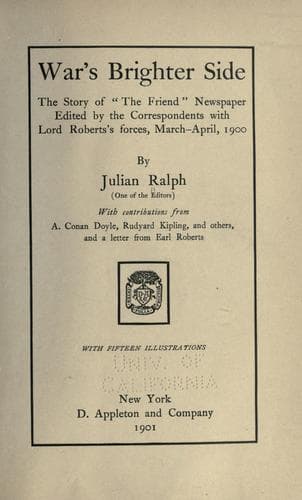
War's Brighter Side: The Story of The Friend Newspaper Edited by the Correspondents with Lord Roberts's Forces, March-April, 1900Ralph, Julian
History
War's Brighter Side: The Story of The Friend Newspaper Edited by the Correspondents with Lord Roberts's Forces, March-April, 1900
Ralph, Julian
Friend (Bloemfontein, South Africa); South African War, 1899-1902 -- Periodicals
Steevens turned wearily, and remarked, "Well, it is a strange sideway
out!" Then there passed over his face an expression which plainly
read, "I will not die!"
He turned to Maud and said, almost gaily, "Let's have a drink."
Maud opened a new bottle of champagne and poured out half a glass.
Steevens sipped it, and noticing that Maud had no glass, remarked,
"You are not drinking!"
He seemed better after the wine, and when the last message was
dictated he was still struggling for life; but the disease had the
upper hand, and he sank into unconsciousness which was never broken
until he passed away in the evening.
We buried him at midnight. As we took him down to the cypress grove,
it seemed that the enemy paid tribute to our sorrow, for their
searchlight played full upon the mournful cavalcade as it wound into
the open.
* * * * *
SHOULD BEARDS BE WORN IN WAR?
BLOEMFONTEIN, _March 23, 1900_.
DEAR SIR,--A distinguished General Officer--who is also an exceedingly
clever man--was issuing orders on one occasion. "I have no wish," said
he, "to interfere with the time-honoured Custom which ordains that
heroes may be dirty; but, until they become heroes, I see no reason
why they should not try and look like soldiers. The troops under my
command will, therefore, shave until they arrive at the actual front."
This witty sentence provides me with an admirable text for a sermon on
a subject very near my heart. Our troops have, indeed, proved
themselves heroes. Whatever may be the opinion expressed now and
hereafter upon many things in the conduct of this war, upon one thing
there can be no dissentient voice--I refer to the splendid heroism of
our troops. Yes, sir, they are heroes. But why, oh! why do they not
try and look like soldiers too? Why should the erstwhile smart
Guardsman, the dandy Highlander, the dapper Horseman, adopt the facial
disguise of a poacher out of luck, or rather--for the beard is not a
good one--of a member of the criminal classes previous to the Saturday
evening's ablutions? Surely soap can be purchased, razors ground, and
water heated.
It is universally admitted that one of the chief duties of a soldier
is to be smart in his appearance, and the fact that on active service
there may be some difficulty is surely no excuse for its neglect. In
all other periods of the world's history shaving was looked upon as
one of the chiefest necessities in time of war. Napoleon's Old Guard
shaved, as is well known, throughout the entire retreat from Moscow;
there was not a hair upon the faces of Hannibal's legions the day
after the famous crossing of the Alps, while Caesar's well-known
order, "Ut barbas tondeant," must be familiar to every schoolboy. I
might come down to our own times and quote the Queen's Regulations,
but I refrain from doing so lest I should be accused of priggishness.
Public-domain text, read in full here on John Shaqi.
Reviews
Reviews
No reviews yet
Be the first to share your thoughts on this work.
Elsewhere in the archive
Join the Discussion
Join the discussion
Sign in to leave a comment or review.
Sign InorCreate an account