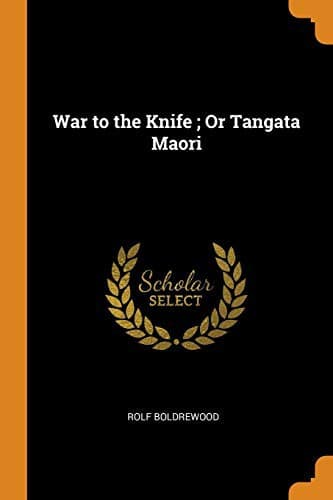
"War to the Knife;" or, Tangata MaoriBoldrewood, Rolf
General
"War to the Knife;" or, Tangata Maori
Boldrewood, Rolf
Māori (New Zealand people) -- Fiction; New Zealand -- Fiction
At Te Ranga was the last stand made by the Maori for the possession of
the lands of his forefathers. No more might he roam whither he would by
river and mountain, by lake, shore, or forest stream. The white man's
axe rang ceaselessly in his ancient woodlands; the white man's fields,
his crops and fences, raised barriers to free untrammelled wanderings
from sea to sea. Only in allotted districts, marked out by the white
surveyor, would he be permitted to live out his life. Even there, the
white man's school, the white man's church, the white man's policeman,
would be always with him. In the place of the chief who administered
justice and delivered sentence without remonstrance, without appeal,
there sat the white man's magistrate, hearing evidence which he did not
always understand, fining and imprisoning for offences against laws of
which they had neither experience nor comprehension.
This was the state of matters to which the Maori nation had come in the
opinion of the older men of the tribes, and not a few of the younger
warriors who had never quite given in their adhesion to the rule of
the stranger. Haughty and tameless as a race, showing by a thousand
instances their preference for death before dishonour, such was their
state of feeling at this time, that had there been any other land
available, they would probably have trooped away in one great migration
like the Moors out of Spain, there to learn to forget their hopes and
fears, their triumphs and their despair, far from the snow-crowned
ranges, the rushing rivers, the fertile valleys, and fire-breathing
mountains of their own loved land.
On the whole, perhaps, it was as well for them, and by no means to
the injury of the usurping pakeha, that the ever-girdling sea forbade
a national exodus. Stern foe as the Briton has ever been while the
fighting lasts, he is the most just and merciful of the world's
conquerors. Of the great Roman, when the sandals of his legions trod
over the prostrate peoples of the inhabited earth, it is recorded that
he permitted them such personal and civic liberty as they had rarely
enjoyed under their own rulers. Still, the privilege and boast of
uttering the magical words, _Civis Romanus sum_, had to be paid for
largely, as in the Apostle Paul's case. More liberal still, the Briton
presents his beaten foe with the priceless gift of his equal laws,
his equal suffrage. The ægis is thenceforth held over him, as of a
blood-brother and a peer, a citizen of that world-wide empire scarce
arrested by the poles, which rules and guards by its laws so large a
proportion of the inhabitants of our planet.
* * * * *
Public-domain text, read in full here on John Shaqi.
Reviews
Reviews
No reviews yet
Be the first to share your thoughts on this work.
Elsewhere in the archive
Join the Discussion
Join the discussion
Sign in to leave a comment or review.
Sign InorCreate an account