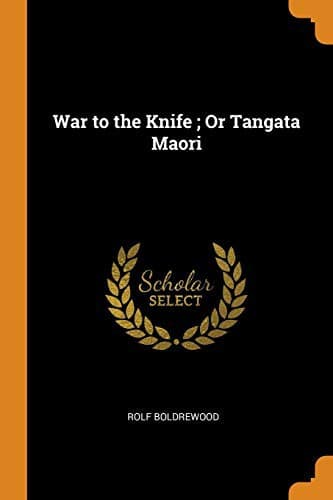
"War to the Knife;" or, Tangata MaoriBoldrewood, Rolf
General
"War to the Knife;" or, Tangata Maori
Boldrewood, Rolf
Māori (New Zealand people) -- Fiction; New Zealand -- Fiction
The newly made friends--for such they were fated to be in the
after-time--walked on a path parallel to the sea, over several deep
ravines crossed by temporary bridges, until they came to a clear space,
in front of which a bold bluff looked out upon the harbour. Here a
collection of huts, made of the _raupo_, or reed-rush, and the smoke of
fires, denoted the presence of the ambassadors of the former lords of
the soil.
"_Haere Mai! Haere Mai!_" was the cry with which they were greeted,
which Massinger rightly interpreted as a note of welcome. His
companions replied with a phrase which appeared to be the correct
antiphonal rejoinder. As they reached the camp, in which they noted
a number of women and children, it was evident that they were
favourably known to the _hapu_, or family section, of the by no means
inconsiderable Ngatiawa tribe.
The chief himself, an intelligent and determined-looking man, thus
addressed them--
"Welcome! My welcome is to you, captain! You have been a friend to the
Ngatiawa as long ago as when Honii Heke cut down the flagstaff; and my
welcome is to you--Herekino. When your ship was in Kororarika, your
heart was to our tribe."
"My salutation," said Macdonald, "is to you, O Te Rangitake! My friend
and I, also this Pakeha Rangatira, have come to you for words in this
quarrel of Otakou in Auckland today. It is folly--let it not breed
quarrels between us. It was the act of a nobody, a _tutua_.
"The heart of Otakou is sore," replied the chief, gravely. "He was
mocked by the pakeha. His _mana_ was injured. He wished for _utu_, but
I told him there were matters to be considered; that the tribe was in
_runanga_ concerning the Waitara land--our land, the land of my people.
After that he can take his musket in his hand. It is his own affair."
"It was a folly, a child's trick. The pakeha was beaten by him. He fell
on the ground. His countrymen would not defend him. He had done wrong.
Were they afraid of forty or fifty Maoris? No! They knew that the
pakeha had done wrong. They would not lift a finger for him."
"It is well," said the chief; and advancing a few steps, he spoke
rapidly to the insulted warrior, who sat moodily alone. "The Rangatira
with the white man says the pakeha has done wrong. His people disown
him. The matter is ended." Here he broke a wand which he carried in his
hand in two pieces, in token that the decision was complete. Upon which
the countenance of the insulted Maori cleared visibly; he arose, and
walked to the other side of the camp.
And now Mr. Lochiel commenced a conversation in Maori with the chief,
which evidently was more important, and, as it proceeded, became deeply
interesting. The flashing eye of the chief, his impetuous words, his
frowning brow, and ever and anon the deep, resonant tones of his voice,
intimated so much.
Public-domain text, read in full here on John Shaqi.
Reviews
Reviews
No reviews yet
Be the first to share your thoughts on this work.
Join the Discussion
Join the discussion
Sign in to leave a comment or review.
Sign InorCreate an account