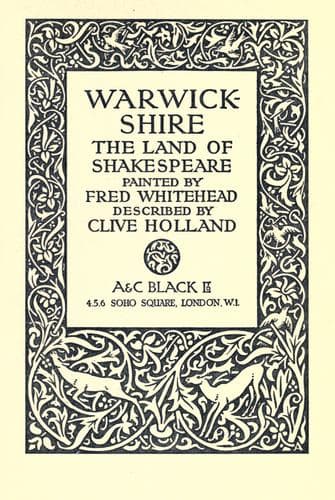
Warwickshire: The Land of ShakespeareHolland, Clive
History
Warwickshire: The Land of Shakespeare
Holland, Clive
Warwickshire (England) -- Description and travel
“George Eliot’s” father, Mr. Robert Evans, was agent for the Arbury
Estate, and the family afterwards, whilst the future novelist was quite
a child, removed to a larger house at Griff.
As was perhaps not unnatural, “George Eliot” drew much of her early
inspiration and local colour from the immediate neighbourhood in which
she was born, and in “Mr. Gilfil’s Love Story,” which she commenced to
write on Christmas Day 1856, Astley Church appears under the disguise
of “Knebley Church”; whilst Sir Robert Newdigate, who collected so many
Art treasures for his beautiful home of Arbury, figures in the same
story under the name of “Sir Christopher Cheverel.”
CHAPTER X
THE STORY AND ROMANCE OF SOME SOUTH WARWICKSHIRE MANOR–HOUSES
Some twelve miles to the south–east of Stratford lies Compton
Wynyates, one of the most interesting and picturesque manor–houses
in Warwickshire, reached by a road scarcely more than a by–way from
Upper Tysoe, and lying beautifully situated and secluded in a thickly
wooded dell. Scarcely seen until one comes quite close to it, at first
sight it gives merely an impression of a multitude of gables, turrets,
and chimneys, with the central porch flanked by two picturesque
half–timbered gables partly overgrown by creepers and ivy.
The whole building except the gables is battlemented, and the ancient
chimneys of zigzag and cable pattern give it an additional and unique
picturesqueness. The old moat which formerly surrounded it has been
filled in, with the exception of a portion to the north, now enclosing
a beautiful flower–garden, which was very probably in former days
covered with buildings.
The name Compton Wynyates is supposed by many to have been derived
from the fact that in ancient times a vineyard was situated on the
slopes which surround the house, and the weight of tradition is also in
favour of this derivation. The property has been in the possession of
the Compton family since the reign of King John, and although records
are lacking to support the view, it seems possible that it came into
the hands of the Comptons at the date of the Conquest. But, although
in the reign of Edward III. one John de Compton was a knight for the
shire in Parliament, the family appear not to have gained any great
distinction until the beginning of the sixteenth century.
At the end of the fifteenth century William Compton succeeded his
father Edmund, but being then only eleven years of age he became a
ward of the Crown, and was brought up with Henry VIII. His association
with the latter was destined to bear very material fruit in the way of
advancement in later years, as, becoming a great favourite with Henry,
he eventually received several important appointments in the State.
Old Fuller, the chronicler, says of Compton, “He was highly and
deservedly a favourite to this King, so that, in the Court, no laymen,
abating onely Charles Brandon (in whom affection and affinity met), was
equall unto him.”
Public-domain text, read in full here on John Shaqi.
Reviews
Reviews
No reviews yet
Be the first to share your thoughts on this work.
Elsewhere in the archive
Join the Discussion
Join the discussion
Sign in to leave a comment or review.
Sign InorCreate an account