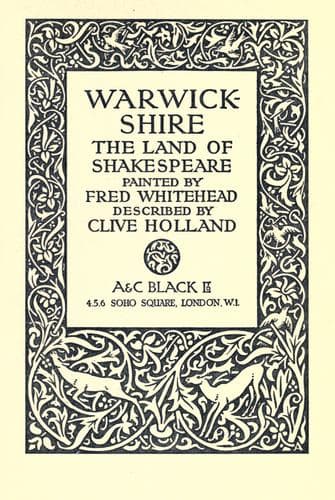
Warwickshire: The Land of ShakespeareHolland, Clive
History
Warwickshire: The Land of Shakespeare
Holland, Clive
Warwickshire (England) -- Description and travel
On entering the house one passes the Buttery on the left, divided from
the Hall itself by an oak screen carved in the linen–fold pattern, and
from this a short passage leads to the kitchens, which still contain
the large recessed fireplaces of Tudor times.
Between the chapel and the Hall is the great parlour, with its oak
panelling and plaster ceiling bearing the arms of Compton and Spencer,
built in the reign of Elizabeth by William Compton, first Earl of
Northampton.
[Illustration: STRATFORD–ON–AVON—THE GRAMMAR SCHOOL.]
The great Hall itself extends the full height of the house, and
possesses a fine open–timbered roof, the beams of which spring from a
richly carved cornice. The roof was apparently brought from some older
building and reduced in size to fit its present use. It is probable,
too, that it originally extended one bay farther, which would give it
its true proportions.
At one end is a picturesque half–timbered Minstrel Gallery, with open
panel–work, the gallery in the south–east angle being a modern addition.
There is an interesting survival of the games of our ancestors in
the huge slab of elm, over 23 feet in length and 30 inches in width,
which was made to rest on tressels, and in all probability was used
for playing “shovel–board,” a popular amusement in the sixteenth and
seventeenth centuries.
It was in this Hall that the builder, Sir William Compton, received
Henry VIII., with whom he had been at the Field of the Cloth of Gold,
and doubtless it has been the scene of many almost equally notable
festivities during the centuries which have passed since its erection.
The Chapel, which is on the south side of the quadrangle, is divided
into two portions by an oak screen with a gate in the centre. Over the
screen are carved panels, and on the left of the gate on the outer
side is one probably representing the scourging of Christ previous to
the Crucifixion; whilst that on the left represents a female figure on
a pedestal intended apparently for the Virgin Mary, the stag having
reference to the legend of St. Hubert. Within the screen on the left
are representations of the seven deadly sins, each mounted on a horse
with a small demon behind, urging on the rider. At the head of the
procession is a monk, and the figure of the devil is seen standing
ready to receive them. On the right–hand side there is a carving of
figures (probably Twelfth Night mummers) in State robes, having swords
in their left hands. The centre panels on both sides of the screen
are blank. The general impression is that these carvings, which are
certainly of greater age than the house, were brought from Fulbroke
Castle, built by John, Duke of Bedford, in the reign of Henry V., the
custody of which was given to Sir William Compton by Henry VIII.
Public-domain text, read in full here on John Shaqi.
Reviews
Reviews
No reviews yet
Be the first to share your thoughts on this work.
Elsewhere in the archive
Join the Discussion
Join the discussion
Sign in to leave a comment or review.
Sign InorCreate an account