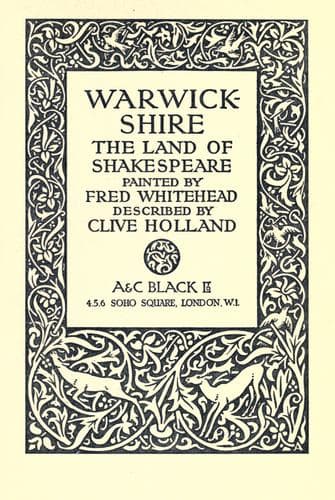
Warwickshire: The Land of ShakespeareHolland, Clive
History
Warwickshire: The Land of Shakespeare
Holland, Clive
Warwickshire (England) -- Description and travel
Some eight miles south–west of Compton Wynyates, retired from the
Oxford Road, stands the interesting, picturesque, and considerable
manor–house of Little Wolford. With its ancient courtyard, shaded by
yews and gay in summer with hollyhocks and other old–time flowers, it
is still a fine specimen of a half–timbered stone mansion of the early
part of the sixteenth century. Formerly belonging to the Ingraham
family, the place has fallen into decay, and from its old estate as a
considerable and picturesque mansion.
The Hall, which possesses an open timbered roof, has a good Tudor
fireplace, and on the walls are hung old portraits of former owners,
and relics in the shape of saddlery and arms, said to have been used
during the Civil War. At the back of the house is a chamber with a
large oven, in which, tradition asserts, rightly or wrongly, Charles
II. hid when a fugitive after Worcester fight.
CHAPTER XI
SHAKESPEARE’S LIFE AND SHAKESPEARE’S TOWN
The history of Stratford–on–Avon, which takes its name from the Saxon
stroete or street, in allusion to the highway on the great north road
leading from London to Birmingham and Holyhead, and the _ford_, from
the passage of the Avon, which in ancient times ran parallel with
the bridge of fourteen arches erected by Sir Hugh Clopton at his own
expense in the reign of Henry VII.
The existence of the town can be traced to a date some three centuries
prior to the Norman Conquest, but historical details of its early days
are scant, although there was in the seventh century a Saxon monastery
possessed by Æthelard, one of the subordinate kings of the Wiccians.
This foundation was, however, in all probability, dissolved a couple
of centuries later. Although doubtless the Celtic invader, the proud
legions of Rome, and the Saxon settlers who succeeded the latter, all
visited Stratford, which from time immemorial must have been a “sweet
and pleasant place of good pasturage and watering,” there exist no
records of those long–past days, when the great Forest of Arden covered
with an almost impenetrable boscage the whole country which lay between
the Avon to the south and Watling Street to the north, to whose depths
and fastnesses the original inhabitants retreated in front of the
invaders who, afflicting Britain, found their all–conquering way at
times even into the heart of England itself.
In the immediate neighbourhood of Stratford are many survivals of
Celtic origin in the nomenclature, and there are some authorities who
seek to trace some measure of Shakespeare’s poetic genius to a remote
and long–forgotten Celtic ancestry.
Public-domain text, read in full here on John Shaqi.
Reviews
Reviews
No reviews yet
Be the first to share your thoughts on this work.
Elsewhere in the archive
Join the Discussion
Join the discussion
Sign in to leave a comment or review.
Sign InorCreate an account