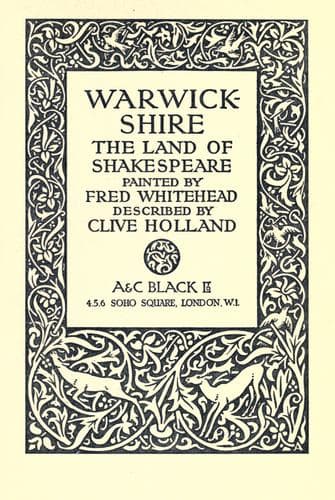
Warwickshire: The Land of ShakespeareHolland, Clive
History
Warwickshire: The Land of Shakespeare
Holland, Clive
Warwickshire (England) -- Description and travel
Anciently the town stood almost on the edge of the Wooland or Woodland
district, in contradistinction to the Feldon, which was less thickly
afforested. At even so late a period as the times of the poet Camden
speaks of the greater part of the district as thickly wooded, although
possessing tracts of pasture and land given over to corn. Probably the
immediate neighbourhood very closely resembled the more thickly–wooded
portions of the New Forest of the present day.
The first record of the existence of a place of any importance is the
entry in the Domesday Book where, in 1085, is given a valuation of the
manor; that then appears to have consisted of barely 2000 acres, which
land was in the occupation of men who were to all intents and purposes
villeins. The lord of the manor, at the time of the Survey, was the
Bishop of Worcester, to whose see the town belonged, King Ethelred of
Mercia having given the monastery in 691 to Egwin, the third bishop of
the diocese. This monastery is generally supposed to have been founded
by the river side on that exquisite site now occupied by Holy Trinity
Church.
Unhappily the history of this monastic foundation, which one may well
believe would have been of supreme interest, is almost untraceable.
But that it was not an altogether tranquil one may be inferred from
the records which state that strife between the succeeding Bishops of
Worcester and the Kings of Mercia for its possession and that of the
town was not infrequent. Both the town and the monastery undoubtedly in
those early times were interdependent, and the first houses, of which
there were apparently about two score at the time of the Conquest,
were probably near the site of the monastery and river, and were in
the neighbourhood of the thoroughfare now known as the Old Town.
The manorial mill, at which the inhabitants ground their corn, was
situated below the ford, and for this privilege they paid the usual fee
taken by the lord of the manor for such convenience. In those early
days of Stratford’s existence, before grave and scandalous monastic
abuses ate into the heart of the system of religious foundations,
the countryfolk looked to their ecclesiastical neighbours for active
assistance in their labours and lives. This was undoubtedly the case
with the old–time inhabitants of Stratford. Soon the town not only grew
within its own borders, but spread its influence into the surrounding
district, where clearings were made in the forest, or spaces already
open were put under cultivation and homesteads began to spring up.
Public-domain text, read in full here on John Shaqi.
Reviews
Reviews
No reviews yet
Be the first to share your thoughts on this work.
Elsewhere in the archive
Join the Discussion
Join the discussion
Sign in to leave a comment or review.
Sign InorCreate an account