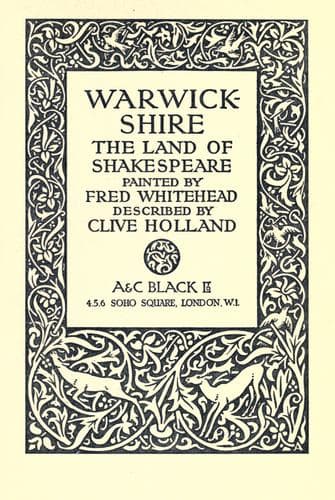
Warwickshire: The Land of ShakespeareHolland, Clive
History
Warwickshire: The Land of Shakespeare
Holland, Clive
Warwickshire (England) -- Description and travel
The first event of any historical importance in connection with “the
town of Stratford by Avon,” and one destined to have a great effect
upon its ultimate growth and importance, was the granting by Richard
I., in the year 1197, of the right to hold a market each Thursday.
This privilege was obtained for the inhabitants by the then Bishop of
Worcester, who charged the townsfolk the sum of sixteen shillings per
annum for it. This market was held on the site of the present Rother
Market, and to it the drovers brought their cattle weekly from the
pastures round about or from the cleared spaces of the Forest of Arden
near by. The word itself serves to preserve a memorial of the nature of
the institution, “Rother” being Anglo–Saxon for horned cattle.
The market, however, appears to have declined in importance towards
the middle of the thirteenth century, but was reinstituted or recovered
its lost popularity in the early years of the fourteenth. In addition
to the market, which, as we have already pointed out, must have been
largely devoted to cattle, five annual fairs were held, which were
doubtless a great attraction to the townsfolk and to dwellers in
the immediate neighbourhood. Four of these were, we find, largely
patronised by drovers, and a great trade was done at them in cattle.
The reason for this circumstance is not far to seek when one takes into
consideration the fact that in the immediate vicinity of Stratford
there were considerable extents of rich pasture land which, from time
immemorial, had been used for herds and flocks. The market frequented
by dealers in other goods and by the wandering pedlars of the Middle
Ages lay around the High Cross, at the northern end of the High Street,
in the space which in those days lay between Rother Market and the
ancient timber bridge across the Avon.
To these fairs doubtless came the inhabitants from far and near; from
the scattered homesteads amid the forest glades of Arden, and from the
manor–houses which began in the thirteenth and fourteenth centuries to
spring up upon the lands granted by successive kings to their vassals
for services rendered or for political reasons. Ultimately there came
to Stratford fairs merchants of East Anglia and enterprising traders
from so far afield as London. Pedlars there had always been from quite
early times.
From the fourteenth century onwards the town appears to have had
no lack of sons interested in her welfare, and amongst the earliest
benefactors were two brothers named Robert and John de Stratford,
and a nephew. The two brothers were destined to become distinguished
ornaments of the Church, the second named being in turn Archdeacon
of Lincoln in 1319, Bishop of Winchester in 1323, and Archbishop of
Canterbury in 1333. Robert being vicar of his native town, then in 1335
Chancellor of the University of Oxford, and two years later he was
consecrated Bishop of Chichester. Ralph de Stratford, the nephew, being
raised to the see of London in 1339.
Public-domain text, read in full here on John Shaqi.
Reviews
Reviews
No reviews yet
Be the first to share your thoughts on this work.
Elsewhere in the archive
Join the Discussion
Join the discussion
Sign in to leave a comment or review.
Sign InorCreate an account