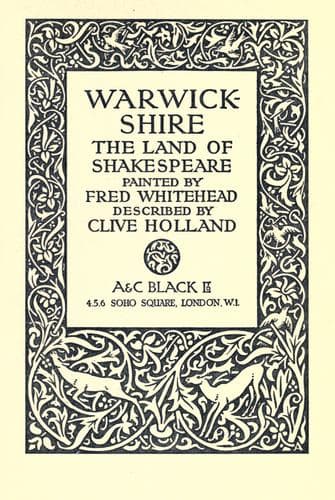
Warwickshire: The Land of ShakespeareHolland, Clive
History
Warwickshire: The Land of Shakespeare
Holland, Clive
Warwickshire (England) -- Description and travel
Only the site, and garden, and a few traces of the foundations of New
Place, Shakespeare’s home in his latter years, remain. Nothing of the
mansion originally erected for Sir Hugh Clopton has been left standing.
The fact that it was probably the most imposing residence in the town
in Shakespeare’s time affords interesting evidence of the prosperity
which undoubtedly came to him from his companies of players and the
performance of his plays. On acquiring the property of New Place,
Shakespeare made considerable alterations to fit it to his requirements
and ideas; the house at this time having two gardens attached to it,
one small and one larger. It is probable that the famous mulberry tree,
which was in all likelihood one of a considerable number distributed
through the Eastern Counties and Midlands by a Frenchman of the name
of Verton or Verdon in 1609, was planted by the poet in the smaller
garden. Of the great garden Shakespeare made an orchard, and in it
there is some evidence that he passed much of his time. Prior to the
year 1609 the house was occupied by one Thomas Greene, Town Clerk of
Stratford, who claimed cousinship with the poet; and after the latter’s
death in 1616 the property descended to his married daughter, Mrs.
Hall, and here in 1643 she entertained Henrietta Maria, consort of
Charles I.
After passing through several hands the house and property came into
the possession in 1753 of the Rev. Francis Gastrell, Vicar of Frodsham,
in Cheshire. This event afterwards proved to be fraught with disastrous
consequences, for the Vicar, cursed with a violent and selfish
disposition, soon began a work of destruction upon the Shakespearian
relics, which unhappily for posterity he had acquired. Angered by the
frequency with which travellers, admirers of the poet, and antiquarian
students applied to him for permission to view the celebrated mulberry
tree, in the shade of which Sir Hugh Clopton in 1742 is by tradition
stated to have entertained David Garrick, Dr. Delany, and Macklin,
he proceeded to cut it down. This was in itself an act of vandalism
which would have earned for him an unenviable notoriety for all time;
but far worse was to follow. It appears that during a portion of each
year Gastrell was obliged to be absent, ministering to his flock at
Frodsham. The Stratford local authorities were (from his point of
view) unreasonable enough to expect him to pay his rates all the same.
Resenting their action and to show his anger he promptly had New Place
demolished, and the materials of which it was constructed sold! Thus
vanished for ever, in the act of a maniacal priest, a building only
second in interest and archæological value to the birthplace itself,
leaving but the site and a few traces of the foundations remaining.
Public-domain text, read in full here on John Shaqi.
Reviews
Reviews
No reviews yet
Be the first to share your thoughts on this work.
Elsewhere in the archive
Join the Discussion
Join the discussion
Sign in to leave a comment or review.
Sign InorCreate an account