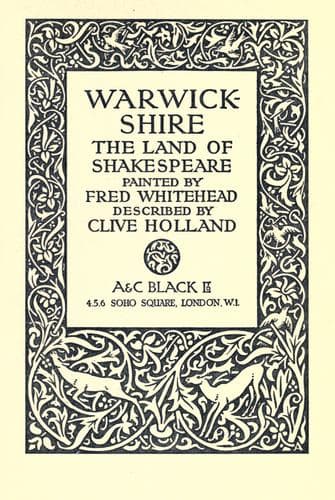
Warwickshire: The Land of ShakespeareHolland, Clive
History
Warwickshire: The Land of Shakespeare
Holland, Clive
Warwickshire (England) -- Description and travel
In addition to the Shakespearian dwellings we have described, there
are a considerable number of domestic buildings and fragments in
Stratford of interest as architectural survivals, but with which there
is no space to deal here. The curious and the serious student of
Shakespeare’s town will have little difficulty and much pleasure in
discovering them.
Exactly opposite New Place, on the other side of Chapel Lane, are
the old Guild Hall and Guild Chapel. The latter anciently the Chapel
of the Guild of the Holy Cross. This organisation, like some of
those of Coventry and other places, was partly religious and partly
secular in character. Although it was certainly in existence in the
reign of Edward I. the actual date of its foundation is unknown. The
ancient governing body of the Guild consisted of two aldermen and six
Councillors, who were fined fourpence if they failed to attend its
meetings. The annual subscription in 1389 was sixpence, and admission
to the Guild was made upon payment of an entrance fee, which varied in
amount according to whether the applicant was married or single. There
were social feasts at various times during the year, more especially
at Easter–tide, and the existing records of these form a valuable
contribution to our knowledge of the habits and manners of those far
distant times.
That Stratford could not in those early days have been a place of great
resource or importance is made clear by the fact that it was necessary
to obtain supplies for these Guild festivities from outside, and keep
the live stock, pigs, fowls, sheep, goats, etc. alive in charge of the
Guild until required.
By the middle of the thirteenth century the Guild had prospered to
such a degree that in 1269 it obtained a license from the then Bishop
of Worcester to build a chapel and hospital. The present Guild Chapel
is the one erected during the earlier part of the fifteenth century,
on the site of the original building. The nave was rebuilt in 1292, in
Henry VII.’s reign, by Sir Hugh Clopton. On the exterior of the porch
are four shields bearing the arms of Sir Hugh Clopton, those of the
city of London (of which he was Lord Mayor), those of the merchants of
the Woolstaple, and the remaining shield bearing what are thought to
be the original arms of Stratford. Early in the nineteenth century a
series of frescoes were discovered in the chapel, which were promptly
whitewashed over or otherwise destroyed; fortunately, however, not
before one Thomas Fisher had made a series of drawings, which in some
measure permits us to realise the character of the pictures; the
subjects were “The Doom,” “The History of the Holy Cross,” “The Combat
between St. George and the Dragon,” and “The Martyrdom of St. Thomas
of Canterbury.” A fragment of a fresco (a figure with mutilated legs
bearing a shield) is discernible on the west of the arch of the inner
door.
Public-domain text, read in full here on John Shaqi.
Reviews
Reviews
No reviews yet
Be the first to share your thoughts on this work.
Elsewhere in the archive
Join the Discussion
Join the discussion
Sign in to leave a comment or review.
Sign InorCreate an account