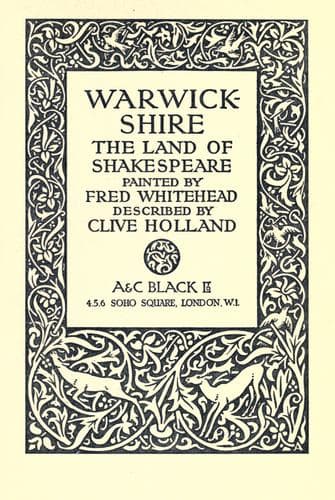
Warwickshire: The Land of ShakespeareHolland, Clive
History
Warwickshire: The Land of Shakespeare
Holland, Clive
Warwickshire (England) -- Description and travel
With this building Shakespeare must have been well acquainted when
a boy, and also as a man. Whilst resident at New Place he, in all
probability, attended it, as there was a pew attached to the property.
Not only is this small building interesting as a survival of a bygone
age, but as intimately connected with at least two portions of
Shakespeare’s life—boyhood, and his later years of residence in the
town of his birth.
Another building of great and enduring interest is the Guild Hall,
an ancient, half–timbered structure standing on the south side of the
chapel, and built in 1296 by Robert de Stratford, but greatly altered
during the fifteenth century. It was erected for the use of the members
of the Guild, and after the dissolution of that body it was granted by
Edward VI. in 1553 to the principal inhabitants, and was later on used
for the purposes of a Town Hall, until the present one was erected in
1768 on the site of a previous building. In 1890, at the south end,
underneath the wainscot, some traces of frescoes were discovered in
the plaster panels. The centre one contains a representation of the
Crucifixion, with the Virgin on one side and a figure (probably St.
John) on the other. In the other panels are coats of arms. It was in
this hall that Shakespeare most probably first became acquainted with
“stage plays” and players, and not, as some suppose, at Kenilworth,
for it was here that travelling companies, invited by the bailiff and
aldermen of the town, used to give performances. The first of these
of which a record exists visited the town in 1569; subsequently the
companies of the Earls of Leicester, Worcester, and Warwick all gave
performances at Stratford; that of the first named in 1587, the year in
which Shakespeare is supposed to have gone to London in their company.
The windows looking out into the street are comparatively modern,
those originally lighting the room being on the opposite side, and at
the south end, which latter window is now blocked up. In the lower
part of the wall are holes, in which the beams supporting the dais or
stage on which the plays were performed were placed. The Armoury, or
“greeting–room,” which is reached from the hall, has good panelling of
the Jacobean period, and the Royal arms over the fireplace were set
up in 1660 as a memento of the public rejoicing which followed the
Restoration. The Muniment Room, reached by a winding staircase, is a
small chamber, in which a large number of interesting documents of the
sixteenth century were discovered some years ago. Above the armoury
is the Council Chamber, an interesting room now used as the school
library. In it is a massive oak table dating from Jacobean times.
Public-domain text, read in full here on John Shaqi.
Reviews
Reviews
No reviews yet
Be the first to share your thoughts on this work.
Elsewhere in the archive
Join the Discussion
Join the discussion
Sign in to leave a comment or review.
Sign InorCreate an account