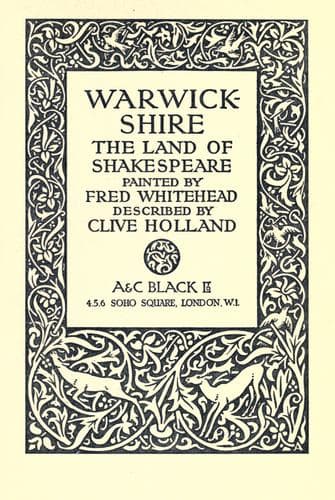
Warwickshire: The Land of ShakespeareHolland, Clive
History
Warwickshire: The Land of Shakespeare
Holland, Clive
Warwickshire (England) -- Description and travel
The great point of interest, of course, is the monument of Shakespeare,
which is on the north wall of the chancel, and consists of a bust of
the poet under an arch, on either side of which are two Corinthian
columns of black marble supporting an entablature bearing his arms,
with a seated cherub on either side, and a skull crowning the top. On a
panel beneath the bust, which was made by Gerard Johnson, a tomb–maker,
who lived near the church now known as St. Saviour’s, Southwark, and
was erected prior to 1623, are the following inscriptions:—
Judicio Pylium, Genio Socratem, Arte Maronem,
Terra Tegit, Populus Moeret, Olympus Habet.
Stay, passenger, why goest thou so fast?
Read, if thou canst, whom envious Death hath plast
Within this monument; Shakespeare, with whome
Quicke Natur dide; whose name doth deck ys tombe,
Far more than cost; sith all yt he hath writt,
Leaves living art, but page to serve his witt.
Obit Ano Doi 1616.
Aetatis 53 Die 23 A.P.
Originally the bust was coloured, but at the end of the eighteenth
century it was given a coat of white paint, which remained on for
nearly seventy years, when on its removal in 1861 sufficient traces of
the original colouring were discovered to permit of restoration.
[Illustration: CHARLECOTE.]
It is generally assumed that the face of this bust was modelled from
a death mask, possibly even from the cast which is now at Darmstadt;
and although either the execution was originally poor or the likeness
has been spoiled by restoration, the monument is, of course, of the
greatest interest to all admirers of the poet, and to those who are
students of his life and works. It is believed that the memorial was
provided by Dr. Hall and his wife, and at all events there seems little
doubt that they superintended its erection.
Close beneath the monument and within the altar rails is the poet’s
grave, with the well–known lines:—
GOOD FREND FOR JESUS SAKE FORBEARE
TO DIGG THE DUST ENCLOASED HEARE;
e t
BLESTE BE Y MAN Y SPARES THES STONES;
e s
AND CVRST BE HE Y MOVES MY BONES.
It is supposed that these lines were written by Shakespeare himself,
fearful lest his remains might be disturbed; for anciently, on the
north side of the chancel, was a charnel–house in which were a large
collection of human bones. This was done away with in 1800.
Public-domain text, read in full here on John Shaqi.
Reviews
Reviews
No reviews yet
Be the first to share your thoughts on this work.
Elsewhere in the archive
Join the Discussion
Join the discussion
Sign in to leave a comment or review.
Sign InorCreate an account