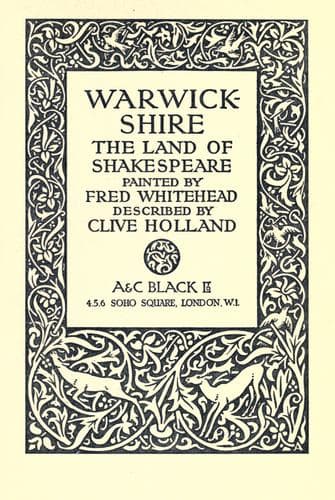
Warwickshire: The Land of ShakespeareHolland, Clive
History
Warwickshire: The Land of Shakespeare
Holland, Clive
Warwickshire (England) -- Description and travel
Next to the north wall, on the left of the poet’s grave, is that of
his wife, who died on August 6, 1623; a Latin inscription on a small
brass plate marking the spot. Close by are also buried Thomas Nash,
the first husband of Elizabeth Hall, Shakespeare’s grand–daughter,
who died in 1647; Dr. John Hall, who died in 1635; and Susannah Hall,
Shakespeare’s daughter, who died in 1649. The original lines on the
grave of the latter were obliterated some time at the beginning of the
eighteenth century, and an inscription to some one else put in their
place. The lines were, however, restored in 1836.
Witty above her sexe, but that’s not all,
Wise to salvation was good Mistris Hall.
Something of Shakespeare was not that but this
Wholy of him with whom she’s now in blisse.
Then, passenger, ha’st ne’re a teare
To weepe with her that wept with all?
That wept, yet set her selfe to chere
Them up with comforts cordiall.
Her love shall live, her mercy spread,
When thou ha’st ne’re a teare to shed.
The stained glass in the east window dates from 1895. The “American”
window, presented in 1885, is situated on the north side of the
chancel, the subject of which is “The Seven Ages of Man.” The choir
stalls are very handsomely carved, and contain grotesques on their
misereres. The fine stained–glass window unveiled in 1896 by Mr.
Bayard, the then American ambassador to this country, is another gift
of admirers of the poet in the United States. The chancel screen, which
now occupies a position across the chancel archway, was originally in
the nave, and the former screen is placed in the north transept and
forms the vestry.
In the Clopton Chapel are to be found a number of excellent memorials
of the family, one of the finest being one against the wall of George
Carew, Earl of Totnes, and Baron Clopton and Joyce his wife. The
effigies of the Earl and Countess, which are of coloured alabaster, lie
under an arch supported by Corinthian columns. The Earl is in armour,
and the weapons and other warlike objects represented on the tomb
commemorate the fact that he was the Master of Ordnance of James I. The
High Tomb, which is without effigy or inscription, has numerous panels
formerly adorned with “latten” shields. It was thought that this tomb
was intended for Sir Hugh Clopton, Lord Mayor of London in 1492, from
the fact that he left directions that if he died at Stratford he was to
be buried there. He was, however, buried in St. Margaret’s, Lothbury.
Another interesting memorial placed against the north wall is that
of William Clopton and his wife Ann. The recumbent effigies are
respectively in armour and in a low–bodiced robe. William Clopton has
his head resting upon his helmet, whilst on the head of his wife is
a close–fitting hood with a peaked front. The tomb also has upon it
effigies of their children, some of whom are depicted as in swaddling
bands, indicating that they must have died in infancy.
Public-domain text, read in full here on John Shaqi.
Reviews
Reviews
No reviews yet
Be the first to share your thoughts on this work.
Elsewhere in the archive
Join the Discussion
Join the discussion
Sign in to leave a comment or review.
Sign InorCreate an account