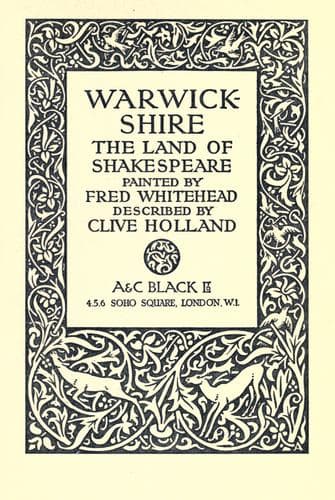
Warwickshire: The Land of ShakespeareHolland, Clive
History
Warwickshire: The Land of Shakespeare
Holland, Clive
Warwickshire (England) -- Description and travel
Amongst the other objects of universal interest in this fine church
are the old font, in which Shakespeare is supposed to have been
baptized; and the ancient register of the church, wisely protected by a
glass case placed at the western end of the north aisle, containing the
entries of Shakespeare’s baptism and burial, and many other records of
interest.
The Shakespeare Memorial buildings, which stand adjoining the Bancroft
Gardens at the foot of Chapel Lane by the river, form an imposing and
fairly picturesque pile in the Elizabethan style of architecture; but
which, frankly, to most people must in its newness appear somewhat out
of character with the general atmosphere of the old town. The buildings
contain a Library; Theatre, capable of seating nearly 900 persons; a
Picture Gallery; and Central Tower. The idea of a national memorial
to the nation’s poet had been several times brought forward prior to
the autumn of 1874, when Mr. Charles E. Flower presented the fine
site on which the Memorial stands, and the sum of £1000, coupled with
the suggestion that the Memorial should take the form of a Theatre. A
committee was formed, and the first stone was laid on Shakespeare’s
Day, April 23, 1877. The Theatre portion was opened on the same day
two years later, and the whole building was completed in 1883. Many
years before, David Garrick had made the suggestion that a “school for
actors” should be founded at Stratford, but this idea—with several
others mooted at various times—was never proceeded with.
In the Library, which is on the ground floor, are more than 10,000
volumes relating to Shakespeare, his works and times; a collection
alike valuable to the student of the poet and to those who would seek
to know what were the modes of life and manners of the Elizabethan
age. The Picture Gallery contains some interesting portraits of famous
actors and actresses, a copy of the Davenant bust of the poet, and
a portrait of Shakespeare, from which some authorities claim that
the Droeshout engraving was made. Whether this latter supposition is
correct or not is still in dispute; and, indeed, around the whole
question of its authenticity has raged a fierce battle, in which many
artists and antiquarians of note have at various times taken part. The
portrait is on an elm panel, and bears date 1609. The most interesting
point is what became of the portrait from which Droeshout engraved
his? For many years it had been untraceable, but some few years ago
the picture in question was presented to the Memorial by Mrs. Flower.
Such well–known authorities as Mr. Sidney Lee and Mr. Salt Brassington
are inclined, for reasons into which it is impossible to enter here,
to accept the portrait as that from which Droeshout engraved his,
with which Shakespeare’s friend Ben Jonson would appear to have been
satisfied as being a good representation of his dead friend. If
authentic, it is unnecessary to add that it forms the most important
relic of Shakespeare we have.
Public-domain text, read in full here on John Shaqi.
Reviews
Reviews
No reviews yet
Be the first to share your thoughts on this work.
Elsewhere in the archive
Join the Discussion
Join the discussion
Sign in to leave a comment or review.
Sign InorCreate an account