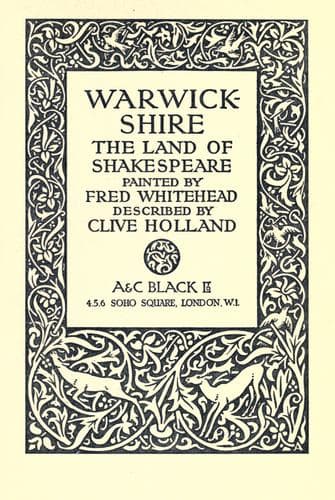
Warwickshire: The Land of ShakespeareHolland, Clive
History
Warwickshire: The Land of Shakespeare
Holland, Clive
Warwickshire (England) -- Description and travel
The village is a very pretty one, and has additional interest in its
fine church, dating principally from the end of the thirteenth century.
Originally the family of Cantilupe erected or possessed a castle here,
some traces of the earthworks of which are still to be seen close to
the River Alne, on the north side of the church. The ancient moat
is quite clearly traceable, and this at flood–tide is filled by the
overflow of the river.
There is a fine half–timbered house in the village (now, alas! split
up into small tenements), which was formerly the hall of the “Guild
of the Blessed Virgin.” The church itself consists of chancel, nave,
north aisle and chapel, and a south porch, and it has at the western
end an embattled tower with pinnacles. The roof, which is probably
the original one, is cradle pattern, with the rafters trussed with
curved braces. There is a somewhat elementary but very interesting
stone carving over the north door of the nave, depicting the Virgin
Mary in bed with the infant Christ, whilst St. Joseph stands at the
foot. The date of this work it is difficult to fix absolutely, but
it seems probable that it dates from the beginning of the fourteenth
century. The western end of the north aisle contains an uncommon newel
staircase, originally intended to serve as a means of communication
between the church and some upper parvise or chamber; but this
apartment can never have been completed, as the stairs lead nowhere.
In the chancel are an interesting triple sedilia, a piscina, and a
credence table, all connected together by means of a moulding, which
terminates in two carved heads. The church also contains a fifteenth
century octagonal font, placed on a short shaft, each face of which is
ornamented by a sunk panel embellished with a quatrefoil placed in a
circle, and having a rose in the centre. At the east end of the church
is the chantry chapel of the “Guild of the Blessed Virgin,” in which
are two old–fashioned open pews, noticeable for the carved poppy heads
which adorn the elbows.
In the chapel are also an ancient _prie–Dieu_, and two old wooden
candelabra, each having five receptacles, and pedestals of carved
foliated work. It is probable that these formerly did service as
“elevation” candlesticks, and were placed on the lower steps of the
altar, to be lighted at high festivals and during the elevation of the
Host.
Most of the woodwork of the church dates from the fifteenth century,
and is well worth examination. To the Shakespearian students the
building, of course, has an added interest from the fact that it
seems very probable that it was here John, Shakespeare’s father, was
married to Mary Arden in 1557. Of the eight villages referred to in the
rhyme traditionally ascribed (but apparently without foundation) to
Shakespeare, which runs as follows—
Piping Pebworth, Dancing Marston,
Haunted Hillborough, Hungry Grafton,
Dodging Exhall, Papist Wixford,
Beggarly Broom, and Drunken Bidford—
Public-domain text, read in full here on John Shaqi.
Reviews
Reviews
No reviews yet
Be the first to share your thoughts on this work.
Elsewhere in the archive
Join the Discussion
Join the discussion
Sign in to leave a comment or review.
Sign InorCreate an account