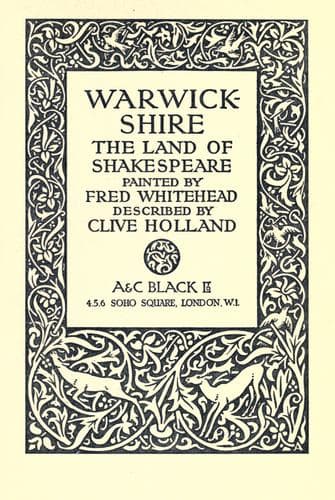
Warwickshire: The Land of ShakespeareHolland, Clive
History
Warwickshire: The Land of Shakespeare
Holland, Clive
Warwickshire (England) -- Description and travel
two, Pebworth and Dancing Marston, are over the borders in
Gloucestershire, and scarcely call for detailed mention here.
Temple Grafton, the “Hungry” Grafton of the rhyme, lies about five
miles south of Aston Cantlow. The village which is prettily situated
on elevated ground was, in the reign of Henry I., bestowed by Henry de
Grafton on the Knights Hospitallers, who afterwards gave a portion of
it to Simon de Arden. It bore the name of Grafton until the reign of
Henry VIII., and it is supposed that the word Grafton is derived from
the Anglo–Saxon _graef_, a moat or ditch, the word “Hungry” being an
epithet given it by reason of the poverty of the soil.
Billesley, a little village lying nearly midway between Stratford and
Alcester, is the third competitor for notoriety as the place where
the poet was married. The evidence in favour of Billesley is entirely
traditional, and may be dismissed, but there is one interesting fact in
connection with the place, _i.e._ that in 1639 Elizabeth, daughter of
Dr. and Mrs. Hall (Shakespeare’s son–in–law and daughter), was married
to Mr., afterwards Sir John, Barnard.
The manor–house at Billesley, comprising the south wing of the original
Elizabethan building, contains a room, the oak panelling of which is
said to have been brought from New Place. This chamber, which is known
as Shakespeare’s Room, is traditionally supposed to have been occupied
by the poet on the occasion of his visits to the house.
Hillborough lies close to the river, some four miles from Stratford,
down a by–road running almost due south from the main road. It is the
“Haunted” Hillborough of the rhyme, although the origin of the ghostly
prefix is lost in obscurity. It is a picturesque stone–gabled building,
beautifully trellised with ivy, which has lost one of its original
wings. Apparently the house dates from Tudor times, but bears traces
of several later additions and alterations. The interior contains an
interesting survival in the shape of ascham or locker for bows and
arrows in the corner of one of the oak–panelled rooms.
Hillborough seems chiefly noted nowadays for its profusion of fruit,
the trees in the garden bearing such heavy crops as to necessitate
their being propped in order to sustain them; whilst peaches and even
grapes ripen and come to maturity on the sunny south walls as they do
in few places in the county.
Public-domain text, read in full here on John Shaqi.
Reviews
Reviews
No reviews yet
Be the first to share your thoughts on this work.
Elsewhere in the archive
Join the Discussion
Join the discussion
Sign in to leave a comment or review.
Sign InorCreate an account