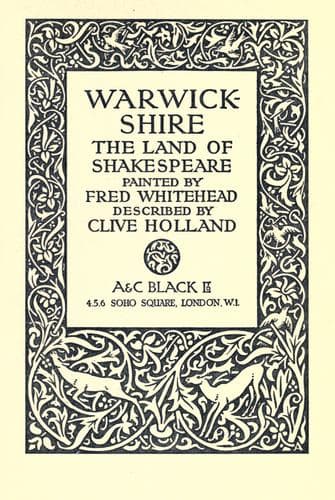
Warwickshire: The Land of ShakespeareHolland, Clive
History
Warwickshire: The Land of Shakespeare
Holland, Clive
Warwickshire (England) -- Description and travel
Travelling westward, about three–quarters of a mile outside Bidford one
comes to a small red–brick barn in a field on the right–hand side of
the roadway. About fifty yards farther, on the opposite side, near by
an iron gate, stands a young crab–apple tree, which, tradition asserts,
sprang from the ancient one known as “Shakespeare’s Crab Tree,” under
which the poet is reputed to have slumbered off the effects of a
drinking bout in which he had taken part at Bidford. The old tree,
however, stood farther in the field. It long ago disappeared, and it is
even doubtful, alas! whether the young tree is, after all, related in
any way to it.
From this point there is a magnificent view of the Worcestershire
hills, and also Ragley Hall, set deeply amid the surrounding woods.
Bidford, one of the most picturesque and charming old–world villages
in Warwickshire, is now speedily reached along the descending road.
There is little doubt that this village, noticeable for its picturesque
and old tiled houses—many of them creeper–grown and quaintly irregular
as regards their architecture—is a place of great antiquity, as it is
situated at the point where the ancient Icknield Street crosses the
River Avon.
Although but a small village nowadays formerly it was a market town,
the lordship of which was anciently given by King John to Llewellyn,
Prince of Wales, on the marriage of the latter to his daughter Joan.
The market was granted by Henry III. in 1220, and was still existent in
the reign of Elizabeth.
Bidford seems to have derived its somewhat unpleasant appellation
of “drunken” from the traditional tale which was published in the
_Gentleman’s Magazine_ in December 1794; wherein it was said that
formerly the village contained an Association or Club of Topers, who
took pride in the quantity of ale they could swallow without falling
under the table. These persons, tradition states, were in the habit
of challenging the residents in neighbouring places to a contest of
endurance, and those of Stratford–on–Avon were on one occasion so
invited to a trial of strength.
The story further states that Shakespeare was one of the party who
came over from Stratford, and with the rest of his companions was
speedily conquered and had to leave the scene of action. It was
whilst on the road home after the contest that Shakespeare and his
fellow–townsmen are stated to have laid themselves down in a drunken
state under the crab–apple tree.
However true or otherwise the story may be, certain it is that Bidford
in ancient times possessed a somewhat unenviable notoriety for
festivity and drunkenness.
Public-domain text, read in full here on John Shaqi.
Reviews
Reviews
No reviews yet
Be the first to share your thoughts on this work.
Elsewhere in the archive
Join the Discussion
Join the discussion
Sign in to leave a comment or review.
Sign InorCreate an account