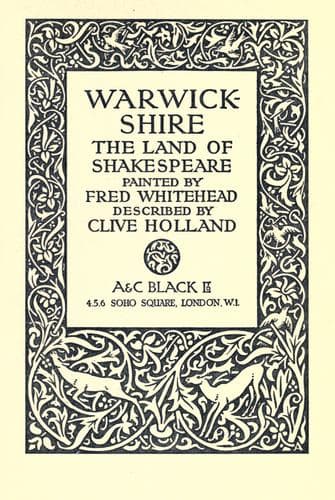
Warwickshire: The Land of ShakespeareHolland, Clive
History
Warwickshire: The Land of Shakespeare
Holland, Clive
Warwickshire (England) -- Description and travel
The house has additional historical interest as the residence, in 1605,
of Ambrose Rokewood, one of the chief conspirators in the Gunpowder
Plot, and from the fact that it was here Catesby, Winter, the Wrights,
and others used to assemble. After the failure of the plot Clopton
was raided by the bailiff of Stratford, and amongst other things,
consisting of papers, etc., was seized a bag containing “copes,
vestments, crosses, crucifixes, chalices, and other massing reliques,”
belonging to the then tenant, a full inventory of which is deposited in
the Museum at Stratford.
In the grounds are several small ponds, and beyond them a spring,
now arched over, where Margaret Clopton is stated to have drowned
herself in 1588, as a result of a love affair. It is supposed that
this incident suggested to Shakespeare’s mind the death of Ophelia,
and there seems some considerable probability that the second scene of
the introduction of “The Taming of the Shrew” is represented as taking
place at Clopton House.
About four miles from Stratford, along the Kineton Road, lies
Charlecote, in a picturesque park prettily situated close to the
junction of the Wellesbourne brook with the Avon. It was here, of
course, that the somewhat apocryphal deer–stealing exploits of
Shakespeare are said to have taken place. Whether there is any
foundation in fact or not for the tradition, it seems certain that
there was some considerable amount of friction at one time existing
between the then owner, Sir Thomas Lucy, and the poet. But whether,
as has been suggested by some, this circumstance had its rise in a
difference of religion, or from some other cause, it has never been
possible to determine. It is supposed by some that at the actual time
the deer–stealing is stated to have taken place there were none at
Charlecote, although there were in the parks of Fulbroke, which also
belonged to the Lucys, and it may even be that it was at the latter
place and not the former that the poaching took place, if at all.
Whatever truth there may be in the story there seems little doubt that
the poet satirised Sir Thomas Lucy in “The Merry Wives of Windsor”
under the guise of “Mr. Justice Shallow.”
The village of Charlecote was granted to Walter de Charlecote by
Henry de Montfort in the reign of Richard I. In the year 1216 William
de Charlecote, son of the original owner, assumed the name of Lucy,
by which the family has ever since been known. The present house,
which was erected by Sir Thomas Lucy in 1558, probably occupies much
the same site as that of the older mansion. With the exception of the
dining–room and library, which were added in 1833, Charlecote remains
to–day practically as it was in the Elizabethan age. It is approached
from the road through an ancient gate–house, one of the most beautiful
and well–preserved specimens of Elizabethan architecture still extant,
the upper story of which is supposed to have anciently been used as a
banqueting–room.
Public-domain text, read in full here on John Shaqi.
Reviews
Reviews
No reviews yet
Be the first to share your thoughts on this work.
Elsewhere in the archive
Join the Discussion
Join the discussion
Sign in to leave a comment or review.
Sign InorCreate an account