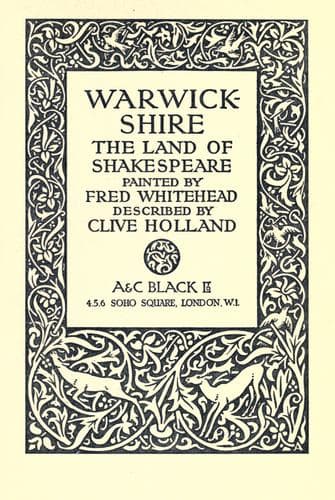
Warwickshire: The Land of Shakespeare — John Shaqi
Warwickshire: The Land of ShakespeareHolland, Clive
History
Warwickshire: The Land of Shakespeare
Holland, Clive
Warwickshire (England) -- Description and travel
In the succeeding reign of Elizabeth the county had its part in the
general progress and prosperity of the nation at large. The fear of
the threatened Armada of 1585 found Warwickshire, as other counties,
ready and willing to furnish its quota of men and money for the defence
of England. And as the time of danger drew nearer and the designs
of Philip of Spain became a reality, the numbers of the levies made
in the county increased, until in December 1587 the Lord–Lieutenant
received orders from the Queen to provide 600 men, properly selected
and equipped. Large loans were also successfully raised, although from
the State Papers one gathers that there were a considerable number of
families, probably Catholics, who objected to contribute. One great
happening only in the county marked this period as one destined to
be ultimately regarded as of worldwide interest and importance. On
April 23, 1564, at Stratford–on–Avon, William Shakespeare, one of the
greatest poets of any age, was born. A genius not alone destined to
reflect undying lustre upon the literature of the wonderfully rich
Elizabethan age, but to survive through succeeding centuries of change
in men, modes of thought and fashion as no other writer has.
Rather less than half a century after Shakespeare’s birth the county
was once more brought into prominence by the famous Gunpowder Plot.
Not only were many of the chief conspirators members of well–known
Warwickshire families, but much of the plotting took place in the
county. The conspiracy, which was intended to compass the death of
King James and his eldest son Prince Henry, and other Protestant
noblemen on the opening of the Parliament in November 1605, was in the
beginning largely the work of one Robert Catesby, of Bushwood Hall,
near Lapworth. Catesby had taken part in the abortive rebellion of the
Earl of Essex in the previous reign, but had been pardoned after having
paid a fine amounting to £3000. He would appear to have been “the born
plotter” he was called by an historian of the period, for he was mixed
up in numerous conspiracies previous to the “gunpowder treason,” which
cost him his life. At one time he was probably a Protestant, as he
married a daughter of Sir Thomas Leigh, of Stoneleigh Abbey.
Public-domain text, read in full here on John Shaqi.
Reviews
Reviews
No reviews yet
Be the first to share your thoughts on this work.
Join the Discussion
Join the discussion
Sign in to leave a comment or review.
Sign InorCreate an account