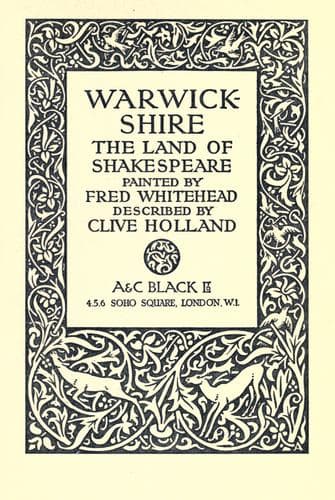
Warwickshire: The Land of ShakespeareHolland, Clive
History
Warwickshire: The Land of Shakespeare
Holland, Clive
Warwickshire (England) -- Description and travel
It was ultimately decided to make a stand at Holbeach House,
Staffordshire, the residence of Stephen Littleton, who had only
recently joined the conspiracy. To reach it they had to ford a river,
and in doing so their arms and ammunition became damp. Whilst drying
the powder in front of the fire a spark fell amongst it; an explosion
occurred, and Catesby, Morgan, Rokewood, and Grant were badly burned;
and several of those who had thrown in their lot with the fugitives
took advantage of the confusion to escape.
On the arrival of the sheriff of Worcestershire and his posse
at Holbeach, the house—which had been seriously damaged by the
explosion—was attacked, and Catesby and Percy, a member of the
Northumberland family, were shot in the courtyard, where they had
intentionally exposed themselves. Rokewood was severely wounded and
taken prisoner with Winter, Grant, Morgan, and several less known
plotters who had retreated into the house. Others were afterwards taken
whilst hiding in the cover afforded by Snitterfield Bushes, some six or
seven miles to the south–west of Warwick.
Thus ended one of the most notable conspiracies in English history, the
heinousness of which has been the subject of much controversy both in
the period immediately following its failure and in recent times. With
the capture and death of the chief participants, and the ultimate trial
and punishment of those who had not succeeded in making good their
escape, Warwickshire once more relapsed into its normal condition of
peace and quietude, from which it was, however, destined to be rudely
awakened by the yet more stirring events of the great Civil War.
At the outbreak of the struggle between Charles I. and his parliament
the county generally declared itself strongly on the side of the
latter; the then owner of Warwick Castle, Robert Greville, Lord Brooke,
being one of the most powerful and bitter of the early opponents of
the King. Prominent upon the side of Charles, however, was found Sir
William Dugdale of Blythe Hall, the antiquary and historian, who,
holding office as one of the royal heralds and as Garter King–at–Arms,
journeyed with the King to Nottingham and made the proclamation when
the royal standard was set up on August 22, 1642. The disastrous Civil
War may be said to have then begun, notwithstanding that two days
previously a hot skirmish had taken place at Long Itchington, some ten
miles to the east of Warwick, between the King’s forces and those of
the Parliament under Lord Brooke and Lord Grey.
Although the first serious encounter between the opposing parties
took place in the neighbouring county of Worcester on September 23,
when Prince Rupert gained an advantage over a body of Parliamentarian
troops, what may be called the first battle of the war took place just
a month later, a little to the south of Kineton, on the plain below
Edge Hill, by which latter name the engagement is known.
Public-domain text, read in full here on John Shaqi.
Reviews
Reviews
No reviews yet
Be the first to share your thoughts on this work.
Join the Discussion
Join the discussion
Sign in to leave a comment or review.
Sign InorCreate an account