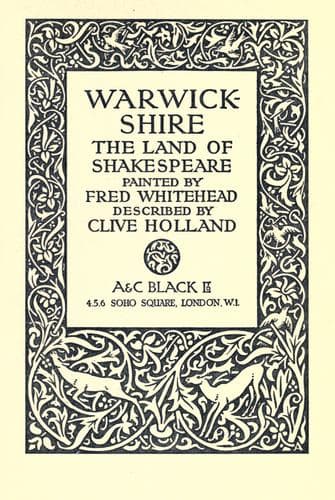
Warwickshire: The Land of ShakespeareHolland, Clive
History
Warwickshire: The Land of Shakespeare
Holland, Clive
Warwickshire (England) -- Description and travel
The chapel is entered by a doorway situated in the south transept of
the church, the hollow moulding of which doorway represents foliage and
the ragged staff, which is the cognisance of the Beauchamps, and above
this is to be seen the Arms of the family on a shield, supported on
either side by the bear and ragged staff.
The interior of the chapel is exceedingly rich; the windows are
imposing ones, filled with good stained–glass, and beneath them are
canopied niches. The ceiling is nearly flat, as is also that of the
chancel of the church; it has groined ribs resembling net–work.
The stalls, situated on each side of the chapel, are of carved oak, the
arms being in the form of bears, griffins, and lions with standards
having carved finials. The altar–piece, which is in low relief,
represents the Annunciation of the Virgin Mary, and is by Collins of
Warwick, who executed the work from a design by Lightoler in 1735. It
is perhaps unfortunate that the altar–piece does not harmonise with the
architectural scheme of the chapel, although the work is good; but the
canopy above is of quite indifferent merit.
There are four monumental tombs of great antiquarian and artistic
value: the centre one that of the founder, Richard Beauchamp, and the
one next to it on the western side the tomb of Ambrose Dudley, known as
the good Earl of Warwick. Against the northern wall is a fine monument
to Robert Dudley, Earl of Leicester, the favourite of Elizabeth, and
his Countess. The recumbent figures of the Earl and his wife are
coloured, and placed on a tomb in front; whilst against the southern
wall is the monument of “that noble impe, the young Lord Denbigh, their
infant son and heir.” These monuments, which represent a period of some
hundred and fifty years, are not only interesting from a historical
point of view, but more especially to students as representing the
changes which took place in the fashion of sepulchral monuments during
that period. A record exists that during the Civil War in 1642 the
Parliamentary forces, under the leadership of Colonel Purefoy, “did
break into the chapel and beat down and deface these monuments of
antiquity.” But it seems probable that their depredations were chiefly
confined to the pulling down of the altar, as none of the tombs show
signs of having been seriously damaged.
Public-domain text, read in full here on John Shaqi.
Reviews
Reviews
No reviews yet
Be the first to share your thoughts on this work.
Join the Discussion
Join the discussion
Sign in to leave a comment or review.
Sign InorCreate an account