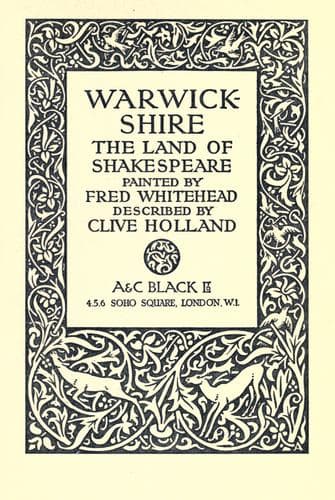
Warwickshire: The Land of ShakespeareHolland, Clive
History
Warwickshire: The Land of Shakespeare
Holland, Clive
Warwickshire (England) -- Description and travel
Few English counties present greater attractions for the student
of the past, the archæologist, the rambler, and the tourist than
Warwickshire. Through it gently–flowing rivers, unagitated by
sudden drops from highland sources, pass on their placid ways by
rich pasture–land and fields of waving corn, or wind in tortuous
convolutions through wide–spread parks, and past historic castles and
mansions rich in traditions of the stirring times when the shire played
its part in the affairs of national history.
Warwickshire, although possessing few ranges of considerable hills, and
no very high eminences, the chief ranges being on its north, eastern
and south–eastern borders, has just that type of scenery which was so
delightfully described by Mrs. Browning in “Aurora Leigh”:—
The ground’s most gentle dimplement
(as if God’s finger touched, but did not press,
In making England!), such an up and down
Of verdure—nothing too much up or down;
A ripple of land; such little hills, the sky
Can stoop to tenderly and the wheat fields climb;
Such nooks and valleys, lined with orchises,
Fed full of noises by invisible streams;
And open pastures, where you scarcely tell
White daisies from white dew; at intervals
The mythic oaks and elm trees standing out
Self–poised upon their prodigy of shade—
I thought my father’s land was worthy too
Of being my Shakespeare’s.
Few better descriptions of the charms of this delightful county have
ever been written, although many poets have sung them. An Elizabethan
singer, Michael Drayton, said of his native shire, “We the heart of
England well may call.”
It was well, indeed, for English literature that such an one as the
Bard of Avon should have been born and have lived in this land of
pleasant pastures, leafy woodlands, and placid and beautiful streams,
and should have treasured early memories of vagrant days amid her
sylvan solitudes and river banks with which to gem his after work with
sweet imageries of rural beauties, of flowers, and the songs of birds.
Shakespeare loved his native town, and he put into almost all of
his plays some glimpses or description of the natural and unfailing
beauties of Stratford and its immediate surroundings. And still, in
the meadows in which long ago he loved to muse and wander, are found
those “daisies pied,” “pansies that are for thoughts,” the “blue–veined
violets,” and “ladies’ smocks all silver white,” of which Shakespeare’s
maidens often sing. And there are also the willow–hung brooks, and the
orchards in spring beauteous in white and pink blossom, and in autumn
rich with sun–kissed fruit.
Public-domain text, read in full here on John Shaqi.
Reviews
Reviews
No reviews yet
Be the first to share your thoughts on this work.
Join the Discussion
Join the discussion
Sign in to leave a comment or review.
Sign InorCreate an account