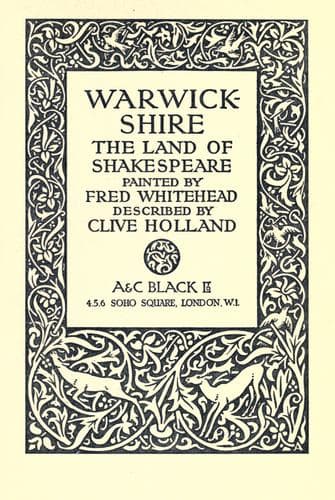
Warwickshire: The Land of ShakespeareHolland, Clive
History
Warwickshire: The Land of Shakespeare
Holland, Clive
Warwickshire (England) -- Description and travel
It is in St. Mary’s Church that the Warwick doles of bread are
distributed on Sunday mornings, irrespective of creed, by the parish
sexton. The doles, which were instituted by Joseph Blissett in 1713,
and a Mrs. Johnson and Mrs. Smith about the same date, consist of
thirty–two loaves, eight threepenny and twenty–four twopenny,—the
former for the married, the latter for bachelors, spinsters, widows,
and widowers. The providing source is derived from rent charges on
houses in High Street and Church Street.
The only other church of interest in Warwick is that of St. Nicholas,
situated almost opposite to the entrance of the castle. The date of its
foundation is not known with accuracy, but it would appear to have been
prior to the Norman Conquest. The present building, which consists of a
tower, spire, nave with aisles, and chancel, was erected in 1780 upon
the site of an ancient church. According to one authority the chancel
was in ancient times the choir to the House of Nuns, destroyed by
Canute the Dane about 1016, but afterwards restored.
Very little can be said for the present erection, which is a very poor
specimen of architecture, and is only of interest in that it contains
some interesting seventeenth–century monuments of the Stoughton family,
and an excellent specimen of a brass with effigy of Robert Willardsey,
first vicar, who died in 1424.
Once a walled town of great strength, of these ramparts scarcely any
traces now remain with the exception of those immediately adjoining
the east and west gateways. Warwick of to–day, with its country town
life and its race–course, seems to have little in common, other than
the survival of interesting buildings and its magnificent castle, with
those ancient times in which the cry of “A Warwick! a Warwick!” often
raised in battle and feud, struck terror into the hearts of those who
heard it.
A little more than a mile to the north of Warwick, on the Coventry
Road, stands the famous Guy’s Cliff, now the seat of the Percy family,
beautifully situated amongst a wealth of trees overlooking a fine
stretch of the Avon. Anciently, and up to the reign of Henry IV., the
place was known as Gibbeclyve, and the name it bears at the present day
would appear to have been given it in memory of the redoubtable Guy of
Warwick, whose somewhat mythical exploits caused him to take a high
place as a popular hero during the Middle Ages.
Unfortunately for those to whom these legendary tales appeal strongly,
there are no mention of Guy’s exploits in any authentic Chronicle or
records of ancient times.
Public-domain text, read in full here on John Shaqi.
Reviews
Reviews
No reviews yet
Be the first to share your thoughts on this work.
Join the Discussion
Join the discussion
Sign in to leave a comment or review.
Sign InorCreate an account