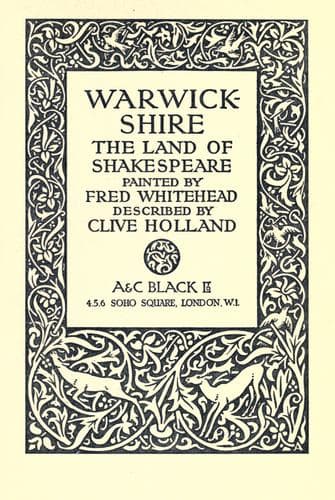
Warwickshire: The Land of ShakespeareHolland, Clive
History
Warwickshire: The Land of Shakespeare
Holland, Clive
Warwickshire (England) -- Description and travel
The history of Warwick Castle and the town are in a measure one, and
may be considered to have commenced in 914, when tradition avers that
Æthelflæd, daughter of Alfred the Great and lady of Mercia, built a
castle here, of which, although almost every other trace has long since
disappeared, the mound may still be seen upon which the original works
were placed.
This same Æthelflæd was one of the most prolific originators of
fortifications in the Midlands, and was responsible for those at
Tamworth and at Stafford amongst others. Some authorities are inclined
to think that Æthelflæd’s efforts as regards Warwick Castle were
merely of the nature of adding to and strengthening already existing
fortifications, which had their origin in the earthworks of the time
of St. Dubritius. But whatever may be the exact truth there remains
no possible doubt that the Mercian princess was largely responsible
for the construction of the great mound which, still bearing her name,
stands at the northern end of the castle.
Early in its history the castle was the scene of many stirring episodes
connected with the struggles of the Conqueror’s immediate successors,
and the long wars which were waged between the King and the Barons. In
the reign of King Stephen, Gundreth, widow of Roger de Newburgh, whose
family held the tide of Earl of Warwick, drove the King’s soldiers
from the castle and surrendered the latter to Henry, Duke of Normandy,
who afterwards became Henry II. A little later, during the Wars of the
Barons, Sir John Gifford, governor of Kenilworth, surprised the castle
of Warwick and carried off William de Mauduit, then Earl of Warwick,
and his lady,—the title having at this period passed to the De Mauduits
through the family of De Plessitis. The then Earl of Warwick had taken
the part of the King against the Barons, and in consequence when the
castle was captured the walls were destroyed, although the towers were
left standing.
Public-domain text, read in full here on John Shaqi.
Reviews
Reviews
No reviews yet
Be the first to share your thoughts on this work.
Join the Discussion
Join the discussion
Sign in to leave a comment or review.
Sign InorCreate an account