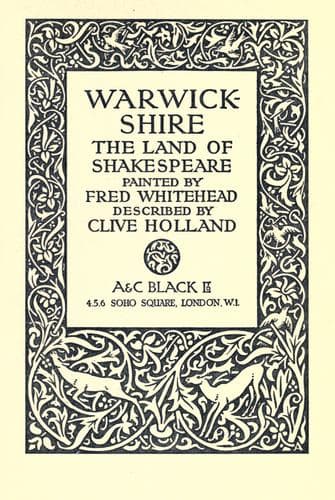
Warwickshire: The Land of ShakespeareHolland, Clive
History
Warwickshire: The Land of Shakespeare
Holland, Clive
Warwickshire (England) -- Description and travel
Four years later the outskirts of Coventry was the scene of one of
the too frequent tragedies of those unsettled times, when Earl Rivers
and his son were beheaded at Gosford Green by the orders of Sir John
Coniers, who had obtained some partial success in Oxfordshire. In
the following year, 1470, the Earl of Warwick, on his return from
France, entered Coventry, which was still Lancastrian in sympathy,
with much war material and hostile intentions to the inhabitants. On
hearing of the Earl of Warwick’s presence King Edward, who lay at
Leicester with his forces, marched thence, and after resting at Coombe
Abbey, proceeded to Gosford Green, and then approaching Coventry
demanded admission; but this being refused, he continued his march to
Warwick. Later on, when he had won the decisive battles of Barnet and
Tewkesbury, and had regained power, Edward, in revenge for the action
of the people of Coventry in refusing to receive him in the previous
year, deprived them of many of their privileges and levied upon them
a considerable fine, amounting to five hundred marks. But the King
soon realised that the good–will of the townsfolk was of too great
importance for him to risk losing it by undue severity; and, therefore,
on payment of the fine, their privileges of which they had been
deprived were again restored to them.
Four years later Edward kept the Feast of St. George at Coventry, and
in the same year his son stood as godfather to the Mayor’s child, and
was presented with a cup and a hundred guineas, and also made a brother
of the Guilds of Corpus Christi and Holy Trinity.
Richard II. also visited the city, and Henry VII. came and lodged at
the Mayor’s immediately after the decisive victory over Richard III. at
Bosworth Field.
It would appear that the people of Coventry of these days were opulent
and generous, but exercised little originality in the form of the gifts
they bestowed upon royal or distinguished visitors, for, like Prince
Edward of York a few years previously, Henry VII. was presented with
a cup and a hundred guineas, and seems to have made so favourable an
impression upon the townsfolk that they a few years later subscribed
£1100 towards the tax which was levied for the purpose of defraying the
expense of the King’s expedition to France.
Public-domain text, read in full here on John Shaqi.
Reviews
Reviews
No reviews yet
Be the first to share your thoughts on this work.
Elsewhere in the archive
Join the Discussion
Join the discussion
Sign in to leave a comment or review.
Sign InorCreate an account