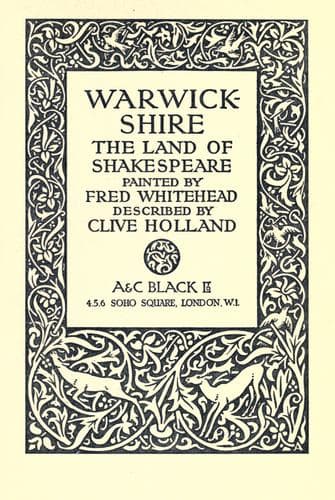
Warwickshire: The Land of ShakespeareHolland, Clive
History
Warwickshire: The Land of Shakespeare
Holland, Clive
Warwickshire (England) -- Description and travel
Henry VIII. and Catherine of Arragon visited Coventry in 1510, and
witnessed three magnificent pageants; and it is possible that the
prosperity of the town, which was popularly attributed as chiefly
owing to the magnitude and wealth of its monastic institutions, may
have suggested to the King’s mind the idea of the ultimate suppression
of these foundations. Be it as it may, it was stated by one John
Hales, Esq., to the Protector Somerset, “that in consequence of the
Dissolution trade grew so low, and there was such a dispersion of
people from this city, that there were not even 3000 inhabitants,
whereas there had been formerly 15,000.” Although this picture of
the desolation wrought by the suppression of the religious houses
is probably painted in too vivid colours, there seems little doubt
that great distress resulted in the years immediately following the
arbitrary action of Henry VIII.’s minister Cromwell, for we find that
although at least one branch of commerce, the clothing trade, was still
flourishing, a charter for an additional fair was granted to alleviate
the distress of the remaining inhabitants.
One of the great features of Coventry life in the Middle Ages was
undoubtedly the wealth and influence of the numerous bodies called
Guilds, which were of both a religious and secular character, and
to the support of these must be attributed much of the fame that
distinguished Coventry for its “mysteries” or sacred plays. These
dramatic performances, which partook of much of the character of that
most interesting and popular survival of the present day “Everyman,”
took place on movable platforms which were drawn through the principal
streets and open places. The subjects of these plays were generally
Scriptural or semi–Scriptural in character, and the different
festivals, more especially that of Corpus Christi, were popular days
for the representations. In addition to these there was at Coventry the
play on Hock Tuesday, which was founded upon incidents of the Massacre
of the Danes, and also pageants which were performed on the occasion of
Royal visits, and at other special times.
On the occasion of Queen Elizabeth’s visit to Coventry in 1565, during
one of her progresses she was received by the sheriffs in scarlet
cloaks and a score of young men on horseback, clad in a livery of fine
purple. The Queen was met at the limits of the liberties of the city
in the direction of Wolvey, and each of the young men presented to
the Queen a white rod, which she receiving delivered to them again,
and they then rode before her until they came near the city, when the
Mayor and Aldermen in their scarlet cloaks came out to receive her. As
was the custom in these times a presentation of money was made; the
Recorder, we learn, presenting “a purse, supposed to be worth twenty
marks, and in it £100 in angels,” which the Queen accepting was pleased
to say to her lords: “It is a good gift, a hundred pounds in gold; I
have but few such gifts.”
Public-domain text, read in full here on John Shaqi.
Reviews
Reviews
No reviews yet
Be the first to share your thoughts on this work.
Elsewhere in the archive
Join the Discussion
Join the discussion
Sign in to leave a comment or review.
Sign InorCreate an account