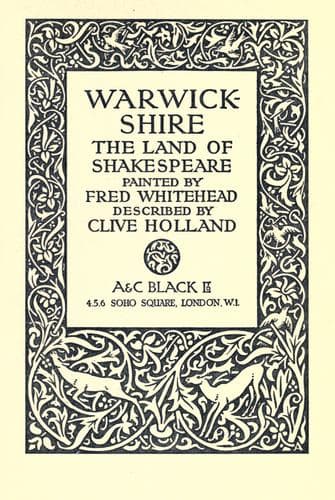
Warwickshire: The Land of ShakespeareHolland, Clive
History
Warwickshire: The Land of Shakespeare
Holland, Clive
Warwickshire (England) -- Description and travel
The clerestory of the church is of the Perpendicular period, and is
divided into eight bays, each containing two windows. The pulpit,
attached to the south–east pier of the tower, is noticeable as being a
fine specimen of stone–work in the Perpendicular style. The font, which
stands on its original base of two steps, has sunk panels painted and
gilt in the Decorated style. The brass eagle is of far greater interest
than usually attaches to these things, owing to the fact that it is
contemporary in date with the church itself, and is also one of the
earliest examples of core casting.
A considerable amount of romance is connected with this lectern, for in
1560 an entry is found in which it is stated that xvjd were expended
“for mendyng of ye Eagle’s tayle,” which had been damaged, possibly
at the time of the suppression of the monasteries. This self–same
eagle was threatened with even greater risk of destruction during the
Commonwealth, for we find an entry in the vestry book of the date of
July 13, 1654, which states “that Mr. Abraham Watts made a motion, that
whereas he was informed that this House had an intention to sell the
brass Eagle standing in the vestrie, that he might have the refusall
thereof when such shall be mede.” An additional entry running, “Agreed,
that if it be sold, he shall have the refusall thereof.” At the time
when the lectern was nearly sold, the font, being in those times
considered an objectionable survival of Romanism, was removed and an
ordinary vessel was provided for use at baptisms. It was, however,
fortunately preserved, and brought back and set up in its original
position after the Restoration.
The handsome reredos was erected in 1873 by Sir Gilbert G. Scott,
R.A., and represents the Crucifixion in the centre, with the Nativity
and Ascension on either side.
An event of more than passing interest in connection with the church
was the marriage, recorded in the register, of Sarah Kemble—afterwards
the famous Mrs. Siddons—with William Siddons, an actor in the
theatrical company of the bride’s father, which was at the time
performing in the Drapers’ Hall.
The Church of John the Baptist, also known as Bablake Church, is
one well worth visiting, especially by students of architecture and
archaeology. It possesses a fine lantern tower with battlements
springing from the centre of the church. Since 1774 it has been the
Parish Church.
Coventry, famous in the past for its religious foundations and
ecclesiastical architecture, was not perhaps less notable for its
buildings of a purely domestic or municipal character, and happily not
a few of these have survived, either complete or in part, to provide
object lessons for the student and the lover of antiquities.
Public-domain text, read in full here on John Shaqi.
Reviews
Reviews
No reviews yet
Be the first to share your thoughts on this work.
Elsewhere in the archive
Join the Discussion
Join the discussion
Sign in to leave a comment or review.
Sign InorCreate an account