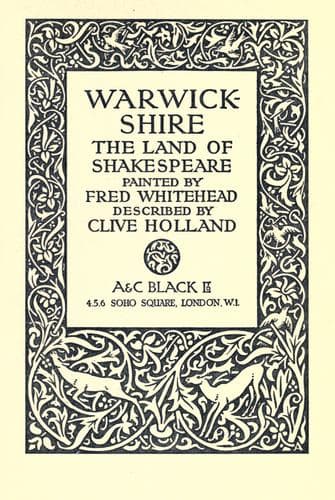
Warwickshire: The Land of ShakespeareHolland, Clive
History
Warwickshire: The Land of Shakespeare
Holland, Clive
Warwickshire (England) -- Description and travel
Amongst the beautiful buildings which make this town still one of
the most interesting in the Midlands, is St. Mary’s Hall, hard by the
church of St. Michael. This fine and ancient building, which, however,
from the dilapidation of the stone–work front, possesses a somewhat
heavy and decayed appearance from the outside, and is too closely
surrounded by other buildings for a good general view to be obtained,
was commenced towards the end of the fourteenth century, and completed
in 1414 by the united Guilds of St. Mary, St. John the Baptist, St.
Catherine, and Holy Trinity, known as the Trinity Guild. Unfortunately,
the front and the tower at the south–west angle has been allowed to
fall into decay, the two upper stories of the latter having long ago
vanished.
[Illustration: THE PARADE, LEAMINGTON.]
The courtyard is entered through the depressed archway leading into
a finely vaulted porch, on the central boss of the groining of which
is an interesting carving representing the coronation of the Virgin,
and on the projecting impost of the inward arch on the right hand is a
representation of the Annunciation; whilst the impost on the opposite
side is ornamented with animal grotesques. There is a lofty room on the
east side of the porch, which was formerly the chapel of the Mercers’
Company. The courtyard lies beyond this, and on the western side of it
is the entrance to the crypt beneath the Great Hall. Near the windows
of the crypt are the ancient lockers, used for the safe custody of
documents and other valuables belonging to members of the Guild. In
the smaller chamber next the street are several relics, not the least
interesting of which is the knave’s post, a figure six feet high,
having arm openings, which was removed from a wall in Much Park Street
in 1886. It came originally from one of the religious houses, and was
the goal of offenders, who, sentenced to be whipped at the cart’s tail,
usually started from the Mayor’s parlour in Cross Cheaping, to which
they were sometimes also whipped back. The last occasion on which a
public whipping was given is supposed to have been between the years
1820 and 1830. The old Coventry stocks, which are also to be found in
this room, formerly standing in the market–place, and last used in July
1861, are threefold, which speaks but ill for the conduct of the town.
Public-domain text, read in full here on John Shaqi.
Reviews
Reviews
No reviews yet
Be the first to share your thoughts on this work.
Elsewhere in the archive
Join the Discussion
Join the discussion
Sign in to leave a comment or review.
Sign InorCreate an account