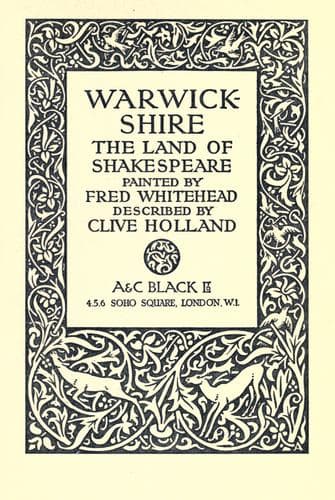
Warwickshire: The Land of ShakespeareHolland, Clive
History
Warwickshire: The Land of Shakespeare
Holland, Clive
Warwickshire (England) -- Description and travel
The Mayoress’s parlour possesses a fine moulded ceiling, in two
compartments, with diagonal ribs united in an octagonal panel. The
fireplace has hollow jambs ornamented with tracery, copied from the
banqueting hall of Kenilworth Castle, and is formed by a depressed
Tudor arch; and above it is a figure of Godiva on horseback placed
in a recess. The elaborately carved state chair of oak undoubtedly
dates from the early part of the sixteenth century, and possibly even
earlier. On one side is the figure of the Virgin and Child, whilst
the other is simply panelled. The back is surmounted on one side by
an elephant and castle—the town arms; and on the other side, which
formerly was the centre, stand two lions acting as supporters for a
coronet or crown, which has disappeared. The chair when perfect was
a double one, and was probably made for the use of the Master of the
Guild, and the Mayor, when present at its meetings. On the walls are
hung some interesting portraits of royalty and of former mayors of the
town.
Amongst the other buildings of Coventry worthy of note as representing
survivals of ancient architecture is the Bablake Hospital, endowed by
one Thomas Bond in 1506. “For”—as it is quaintly phrased—“ten poore
men, so long as the world shall endure, with a woman to look to them.”
This Thomas Bond was a draper of the city, and also its Mayor, in 1497;
when Perkin Warbeck was causing rebellion.
Even a brief consideration of Coventry would be incomplete without
a mention of the famous Guilds which in medieval times played so
prominent a part in its civic history. Of the many founded in the city
the oldest of all having a religious character was that of St. Mary,
which used to hold its annual meeting of Masters, Brothers, and Sisters
on Assumption Day, as the quaint spelling of the time had it, “En sale
n’re dame,” in other words, in St. Mary’s Hall.
As showing the power and importance of this Guild, and, indeed, of
the Guild system itself in ancient times, one only has to remember
the Royal and noble persons who were frequently enrolled as members.
Amongst those who became members of the Guild of Holy Trinity were
Henry VI. and his Queen, Margaret of Anjou; Henry VII. and his Queen,
Elizabeth of York; and Edward V. when he was Prince of Wales. It is
interesting also to record that the name of Shakespeare is included
among the brothers and sisters of the Guild.
Public-domain text, read in full here on John Shaqi.
Reviews
Reviews
No reviews yet
Be the first to share your thoughts on this work.
Elsewhere in the archive
Join the Discussion
Join the discussion
Sign in to leave a comment or review.
Sign InorCreate an account