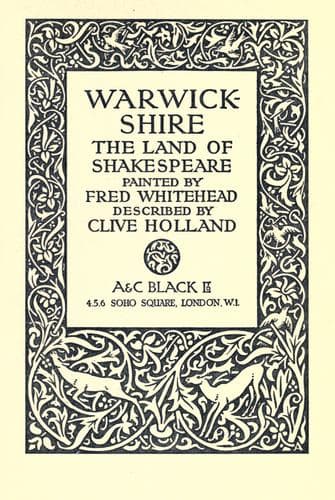
Warwickshire: The Land of ShakespeareHolland, Clive
History
Warwickshire: The Land of Shakespeare
Holland, Clive
Warwickshire (England) -- Description and travel
The form of petition for admission into the Guild, and the oath
which had to be taken by intending members at the ceremony of their
admission, are both quaint; the former runs, “Maister, we beseech you,
at the reverence of the Holy Trinity, that you will receive us to be
brethren of this place with you.” And the latter runs, “Ye shall be
good and true, and each of you shall be good and true to the Master of
the Gild of the Holy Trinity, Our Lady, St. John and St. Catherine of
Coventre, and to all the brethren and sisters of the same Gild; and all
the good rules and ordinances by the said Master and his Brethren afore
this time made, and hereafter to be made, and your days of payment
truly for to keep to your power, so God you help and all Saints.”
[Illustration: ST. MARTIN’S CHURCH, BIRMINGHAM.]
Amongst the other Guilds possessing royal members was that of Corpus
Christi, instituted in the reign of Edward III., which rendered
assistance to the churches of St. Michael and Holy Trinity, by part
payment of the priests; of this Guild King Edward V. was a member.
The Trade Guilds, of which there were many, one of the oldest
being that of the Sheremen and Tailors, founded in honour of the
Nativity some time in the reign of Richard II., were very jealous
of their privileges, and resented promptly any infringement upon
their prerogative. An interesting instance of their action in this
respect was afforded by a combination of the Guilds for the purpose
of suppressing an imitation guild which some of the young men of the
town had formed in the early years of the reign of Henry VI. Dugdale’s
account of this action runs as follows:—
“The common people,” he says, “namely, Journeymen of several trades,
observed what merry–meetings and feasts their masters had, by being of
those Fraternities, and that they themselves wanted in like pleasure did
of their own accord assemble together in several places of the city and
especially in St. George’s Chapel near Gosford Gate, which occasioned
the Mayor and his brethren in the 3rd year of Henry VI. to complain
thereof to the King; alledging, that the said Journeymen in their
unlawful meetings called themselves St. George his Gild, to the intent
that they might maintain and abet one another in quarrels; and for their
better conjunction had made choyce of a Master, with Clerks and Officers
to the great contempt of the K. authority, prejudice of the other Gilds
(viz. holy Trin and Corp Christi) and disturbance of the city; whereupon
the King directed his Writ to the Mayor and Justices, with the Bayliffs
of this City, commanding them by proclamation to prohibite any more such
meetings.”
Thus were the perhaps not unnatural desires of young people of the
Middle Ages to emulate the gaiety and junketings of their betters
crushed by royal authority.
Public-domain text, read in full here on John Shaqi.
Reviews
Reviews
No reviews yet
Be the first to share your thoughts on this work.
Elsewhere in the archive
Join the Discussion
Join the discussion
Sign in to leave a comment or review.
Sign InorCreate an account