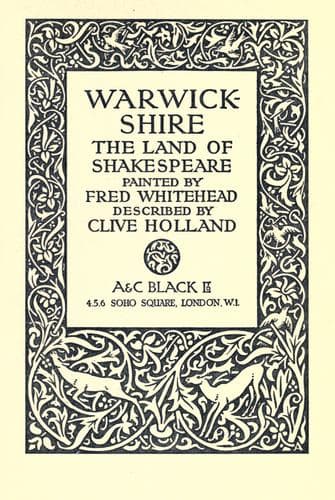
Warwickshire: The Land of ShakespeareHolland, Clive
History
Warwickshire: The Land of Shakespeare
Holland, Clive
Warwickshire (England) -- Description and travel
A descriptive writer gave this war–time picture of Coventry. “It is a
city of ancient greatness inspired with a spirit so modern as to strike
one as being incongruous. There are few lights at night, for it is war
time, but at sunset against the pale lemon evening sky its spires are
sharply silhouetted, and the lofty chimneys of its restless factories
trail diaphanous veils of smoke across the vault of heaven. Even at a
distance one hears a murmurous hum of machines, which comes upon the
evening air like the hum of innumerable bees.... Coventry never sleeps.
In the age of the curfew it slept soundly, its streets dark as now. But
to–day the work is continuous, for only that way can victory lie.”
Yes, Coventry bore its burden, did its share, and played its part.
But, seen from a little distance and from certain aspects, Coventry
still possesses a strange old–world charm, and the more modern elements
of its present–day life seem to fade away, leaving a picture of elegant
spires rising from amid a sea of indistinct and even picturesquely
disposed roofs.
CHAPTER VI
KENILWORTH AND ITS PRIORY—THE STORY AND ROMANCE OF KENILWORTH CASTLE
Kenilworth, which is prettily situated, and lies almost equidistant
between Warwick and Coventry, and about five miles direct north of the
former town, is reached by the turnpike road passing Guy’s Cliff, the
beautiful Blakedown Mill, which existed prior to the reign of Henry
II., and Chessford Bridge. Few who visit Kenilworth at the present
day would imagine that this quiet, straggling country town, with a
population of about four thousand, could ever have played the important
part it did in the history and romance of the county and the nation at
large.
Kenilworth of to–day at first sight gives the traveller the impression
of being merely a sleepy town, with the architecture of its long main
street, which is a full mile in length, picturesquely broken up by the
interspersing of modern and older buildings. Few, indeed, would suppose
that any manufacture of the slightest importance could occupy the
thoughts or the energies of its inhabitants; but there are still some
carried on amid its rural surroundings.
One of the most interesting buildings in Kenilworth is the old
Elizabethan House, standing just beyond the King’s Arms Hotel, at which
Sir Walter Scott put up when visiting the place in 1820. Over the door
of the house, which is of two stories, is a wooden panel on which is
carved a representation of the bear and ragged staff, with the initials
R. L., standing for Robert Leicester. The building was in former times
one of the lodges of the castle, to which the roadway passing the house
leads, thus forming the principal approach. In this house, tradition
asserts, Amy Robsart used to stay, and there is at least a tradition
that years ago a secret underground passage was discovered leading from
the house to the castle.
Public-domain text, read in full here on John Shaqi.
Reviews
Reviews
No reviews yet
Be the first to share your thoughts on this work.
Elsewhere in the archive
Join the Discussion
Join the discussion
Sign in to leave a comment or review.
Sign InorCreate an account