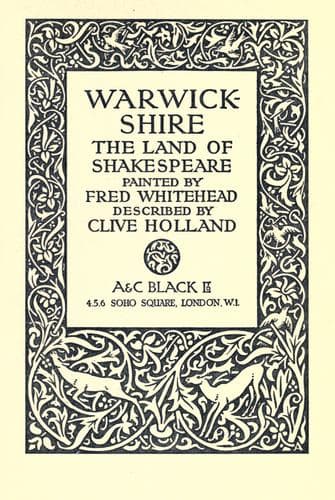
Warwickshire: The Land of ShakespeareHolland, Clive
History
Warwickshire: The Land of Shakespeare
Holland, Clive
Warwickshire (England) -- Description and travel
These trading Guilds were almost analogous to the ancient Companies
of the City of London, and have in many cases survived to the present
time, although nowadays their _raison d’être_ is somewhat far to seek,
and one is forced to the conclusion that the chief excuse for their
continued existence is the feeling that old institutions should not be
allowed to disappear, even though the original and perhaps justified
reasons for their foundation no longer obtain.
In some of the Guilds great and striking alterations have been made
from their aforetime character, although they survive at the present
day. The Guild of Fullers or Tailors and Sheremen, one of the most
ancient, had at one time only one surviving brother, who nominated a
second, and thus it remained until the year 1860, when the number was
once more reduced to a single brother, who then made seven others.
Coventry, now so essentially a commercial city, in ancient days saw,
perhaps, more of change and tragedy than most towns of central England.
In the Middle Ages, indeed, stirring events succeeded one another with
somewhat startling rapidity within its walls, and public executions
were far less uncommon than the inhabitants could have wished. Opposite
the old Black Bull Inn, where Henry VI. stayed after the Battle of
Bosworth Field, and where Mary Queen of Scots was confined for several
months in 1569 (now the site of the Barracks), one Thomas Harrington
of Oxford was beheaded in 1487 for having claimed that he was the son
of the Duke of Clarence. In the garden known as Park Hollows, near
which are some fragments of the ancient city walls, during the Marian
Persecution, several martyrs, including Lawrence Sanders, Cornelius
Bungey, and Robert Glover were burnt for heresy.
From the town of these days it is a far cry, indeed, to the bustling
modern city; still containing, however, somewhat of the philosophy of
ancient civic life, though chiefly concerned with the manufacture of
such modern things as bicycles, motors, and aeroplanes.
Even before the Great War the city was a hive of industry, and its
rapid growth, and the wide extension of its boundaries have been,
indeed, remarkable during the last decade.
To recount Coventry’s part in the waging of the Great War would occupy
far more space than can be devoted to it in a book like the present;
but many of the most essential elements in the ultimate victory had
their origin in the wonderful activities of the ancient town.
War material, munitions, motor cars, aeroplanes, and petrol engines
were turned out in enormous quantities. Thousands of skilled mechanics
were drawn off from industry to play a more active part in the war
overseas, but the older men, women, boys, and girls took their places,
and magnificently carried on the ceaseless activities of providing the
munitions of war.
Public-domain text, read in full here on John Shaqi.
Reviews
Reviews
No reviews yet
Be the first to share your thoughts on this work.
Elsewhere in the archive
Join the Discussion
Join the discussion
Sign in to leave a comment or review.
Sign InorCreate an account