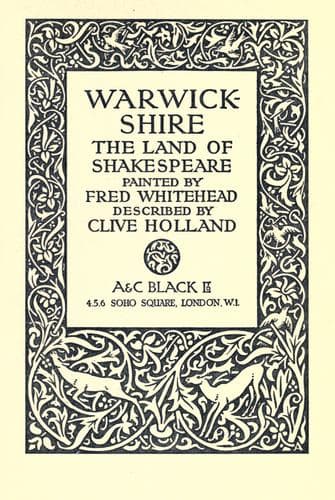
Warwickshire: The Land of ShakespeareHolland, Clive
History
Warwickshire: The Land of Shakespeare
Holland, Clive
Warwickshire (England) -- Description and travel
Very briefly, the real facts concerning Amy Robsart are as follows. The
only legitimate child of Sir John Robsart of Siderstern, she was born
in 1532, and was married at the age of eighteen on 4th June, at the
Royal Palace of Sheen, to Lord Dudley, in the presence of Edward VI.
and many members of the Court. She lived chiefly in the country during
the time that her husband was in attendance on the Court, and ten years
after her marriage, in 1560, was residing at Cumnor Place, rented from
William Owen, a son of George Owen, who had been one of the physicians
to King Henry VIII. At this time there were staying with her a Mrs.
Odingsells, sister of Mr. Hyde, and Mrs. Owen, wife of the owner of the
house.
It was on Sunday, 8th September, that she was found dead at the foot
of a staircase, with her neck broken, by the servants, who had been
allowed to visit the fair at Abingdon. In due course an inquest was
held, and full inquiry made into the circumstances of her death, but
nothing was discovered in the least implicating any one as accessory to
it.
Although Robert Dudley was undoubtedly secretly married at the time
of his Sovereign’s visit to Kenilworth, it was not to Amy Robsart.
Four years previous to the Queen’s visit he had engaged himself to
Lady Douglas Sheffield, whom he had privately married in May two years
later, a son, Robert, being shortly afterwards born to them. This
marriage (concerning the legality of which there seems to be some
doubt) he ultimately endeavoured to repudiate, and at the time of the
festivities at Kenilworth he was actually carrying on a clandestine
intrigue with Lettice, Countess of Essex, whose husband died in the
following year.
In 1578, although Lady Douglas Sheffield was alive, he married Lady
Lettice, who was a daughter of Sir Francis Knollys, and a son was born
to them, who, however, died in 1584. On Leicester’s death it was found
that he had bequeathed the castle for life to his brother Ambrose, Earl
of Warwick, and after him to his son by Lady Douglas Sheffield, whom he
termed Sir Robert Dudley.
The only portion now habitable of what was anciently one of
the finest baronial fortress homes in the kingdom is Leicester’s
magnificent gate–house, which many authorities are agreed equals in its
size and beauty of architecture many a manor–house itself. The old–time
entrance passage of this gate–house nowadays forms two rooms and small
additions. The magnificent fireplace in one of the rooms of the house
is said to be a relic brought from the castle, probably at the time of
its dismantlement by the Parliamentarians.
[Illustration: MAXSTOKE CASTLE.]
The entrance to the castle is through a small gateway, a few yards
distant from the gate–house; and after passing through a strip of
garden the outer court of the castle is reached, and an impressive and
fairly extensive view of the whole building is obtained.
Public-domain text, read in full here on John Shaqi.
Reviews
Reviews
No reviews yet
Be the first to share your thoughts on this work.
Elsewhere in the archive
Join the Discussion
Join the discussion
Sign in to leave a comment or review.
Sign InorCreate an account