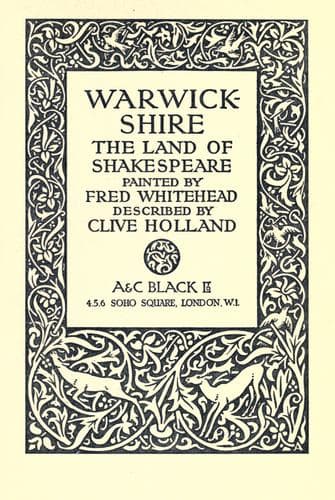
Warwickshire: The Land of ShakespeareHolland, Clive
History
Warwickshire: The Land of Shakespeare
Holland, Clive
Warwickshire (England) -- Description and travel
To those who have never visited Leamington such a description may
not evoke any visions of beauty, but the regularity which marks the
laying out of the town has been wisely tempered by the preservation and
planting, wherever possible, of rows of elms, lindens, and plane trees,
which not only break up the monotony of streets, but impart to the
town an almost garden–like aspect. Notwithstanding, however, the fact
that in the byroads, streets, and avenues of the residential quarters,
more especially of Milverton and Lillington, grass plats separate
the footpaths from the road, adding materially to the beauty and
distinction of the place, the business quarter is no less business–like
than that of other towns. Nathaniel Hawthorne, the American novelist,
has written enthusiastically of Leamington; and those who have resided
in this beautiful spot all the year round can testify that his
statement, that it is a place of charm which is “always in flower,” is
not far from the truth.
The rise of Leamington has been of considerable rapidity, as until the
end of the eighteenth century it was merely an obscure village, and in
the year 1801 the population was only just over three hundred souls,
and the number of houses but sixty–seven.
Its full tide in former years was Leamington Priors, derived from the
fact that the town is built on the banks of the River Leam, and once
belonged to the priors of Kenilworth. In modern days it has become
known as Leamington Spa, the late Queen Victoria, in memory of a
visit she paid to the place in 1838, giving it the title of the Royal
Leamington Spa.
The town is very unlike in appearance its ancient and more celebrated
neighbour Warwick. In fact, whilst the latter has its chief attraction
in antiquity, Leamington has its chief interest as a modern and
fashionable health resort. It is wrong, however, to suppose that
Leamington has no history, and is as entirely modern as its appearance
would lead one at first sight to presume.
The name of the river upon which it stands is of ancient Celtic
origin, and means the elm–tree or elm–bordered stream, and doubtless
in ancient times it was well–wooded for the greater part of its course
on both banks. There are many Celtic river names to be met with in
Warwickshire, and generally these survivals have indicated an ancient
settlement, or at least camp of the invaders, although as regards
Leamington no traces of one now remain if it ever existed.
Public-domain text, read in full here on John Shaqi.
Reviews
Reviews
No reviews yet
Be the first to share your thoughts on this work.
Elsewhere in the archive
Join the Discussion
Join the discussion
Sign in to leave a comment or review.
Sign InorCreate an account