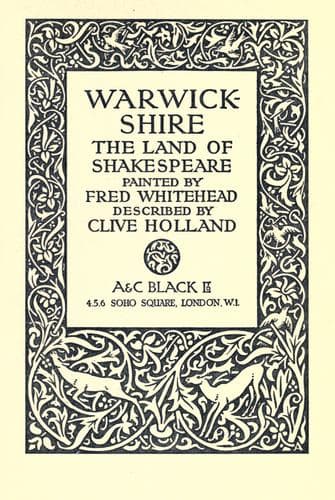
Warwickshire: The Land of ShakespeareHolland, Clive
History
Warwickshire: The Land of Shakespeare
Holland, Clive
Warwickshire (England) -- Description and travel
The town was in ancient times a portion of the very wide possessions
of Turchill, the last and most powerful of all the Saxon earls of
Warwick. In the Domesday Book the estate is put down as containing two
hides, or about two hundred acres of land, the value of which was £4.
There is also a mention of two mills situated on the stream within its
boundaries. Turchill’s son was robbed of this part of his patrimony,
and it was granted by William the Conqueror to a Norman baron, Roger de
Montgomery, who was afterwards created Earl of Shrewsbury.
In those early days the town, or rather perhaps should we say the
hamlet, known as Leamington underwent great vicissitudes of ownership,
for although Roger de Montgomery’s son Hugh inherited the estates, his
brother Robert, to whom they descended during the reign of William
Rufus, called De Beleseme from the name of a castle which belonged
to him, was declared a traitor, and all his possessions, including
Leamington, were seized, and the latter was given to the Bishop of
Lichfield and Coventry. After a few years the possession of it passed
to Geoffrey de Clinton, and was by him granted to Gilbert Nutricius of
Warwick and his heirs, who held it by the service of half a knight’s
fee. For some reason, however, it speedily reverted to the De Clintons,
and Geoffrey de Clinton, son of the original owner, gave it to the
canon and priors of Kenilworth about the year 1166, in whose possession
it remained until the Dissolution of the Monasteries. It remained
the property of the Crown till 1563, when Elizabeth granted it to
Ambrose Dudley, Earl of Warwick. He dying without an heir male, his
title became extinct, and from this period Leamington had many owners,
ultimately coming into the possession of the Earls of Aylesford.
Although Leamington in ancient times had its vicissitudes, there is
little of interest historically concerning it until about the year
1784, when Abbotts made the discovery of a second mineral spring, which
caused attention to be focussed on the medicinal properties of the
Leamington waters. It is doubtless to the discovery of these springs,
and others, may be traced the fact that the town in the first years of
the nineteenth century began to be a place of importance and fashion.
Long before then Camden, Speed, and Dugdale had mentioned prominently
the Leamington Waters; and Fuller in 1662, referring to the same
subject, quaintly observes, “At Leamington, two miles from Warwick,
there issue out, within a stride, [out] of the womb of the earth, two
twin springs, as different in taste and operation as Jacob and Esau
in disposition; the one salt and the other fresh. This the meanest
countryman does plainly see by their effects; while it would puzzle a
consultation of physicians to assign the cause thereof.”
Public-domain text, read in full here on John Shaqi.
Reviews
Reviews
No reviews yet
Be the first to share your thoughts on this work.
Elsewhere in the archive
Join the Discussion
Join the discussion
Sign in to leave a comment or review.
Sign InorCreate an account