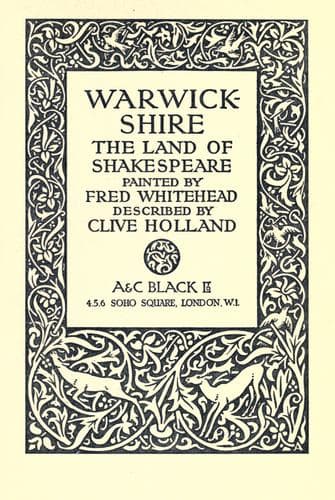
Warwickshire: The Land of ShakespeareHolland, Clive
History
Warwickshire: The Land of Shakespeare
Holland, Clive
Warwickshire (England) -- Description and travel
The derivation of the name has not yet been satisfactorily arrived at,
and by even its most accurate and painstaking historian is considered
“too remote for explanation.” Aided by the erratic spelling of former
times, during the last four centuries alone there have been eight
modes of spelling it,—Burmyngham, Bermyngham, Byrmyngham, Bermyngeham,
Brumychcham, Bromycham, Bromicham, and lastly the more modern and
generally accepted Birmingham. The curious, however, may be set yet
a greater puzzle of selective ingenuity, as from different authors,
documents, records, and papers it is possible to find upwards of a
hundred additional methods of spelling the name of the town which is
popularly known as “the capital of the Midlands.”
Of the eight ways we have enumerated in detail two alone have been in
a measure satisfactorily accounted for; one deriving its origin from a
family, and the other from the situation of the town. Early inhabitants
and even mere settlers of a place in almost every country of the world
were in the habit of describing in their place–names, the mountain,
lake and valley, the moorland and the heath, and also the character,
situation, and size of these; and villages, towns, and cities which
grew up afterwards in these situations were frequently given names
which in a measure described or perpetuated some place or object in
their immediate vicinity, or the actual spot where they were founded.
Dugdale, the historian, is inclined to believe that Birmingham, or
Bromwycham, was a name given by a Saxon owner or settler. In this
regard he says, “The appellation need not be doubted; the last part of
it, viz. ‘ham,’ denoting a home or dwelling, and the former manifesting
itself to be a proper name.”
Hutton, on the other hand, is inclined to make it of an even more
ancient date, and argues that “Brom,” derived possibly from the broom,
a shrub growing freely in the soil of the district, and “wych,”
signifying a dwelling, constituted its original name Bromwych. He
finds, moreover, some confirmation of his opinion from the names of two
other towns in the immediate neighbourhood, West Bromwych and Castle
Bromwych; the terminal “ham,” he argues, being subsequently added, and
up till the time of the Saxon Heptarchy the spot retained its full
name, “Bromwycham.” This argument, however, in reality seems to support
Dugdale’s idea concerning the derivation of the name, as all three
portions of it are of Saxon origin. The alteration locally to Bromicham
was only a contraction, which continued in use down till the eighteenth
century, and indeed is to be traced in the pronunciation of the word
as “Brumijum” by some locals even at the present day. It would appear,
however, that it is more than possible, whatever its ancient name may
have been, and whatever its derivation, that the present–day name
“Birmingham” was given to the place from the owner of the estate rather
than the owner taking his name from it.
Public-domain text, read in full here on John Shaqi.
Reviews
Reviews
No reviews yet
Be the first to share your thoughts on this work.
Elsewhere in the archive
Join the Discussion
Join the discussion
Sign in to leave a comment or review.
Sign InorCreate an account