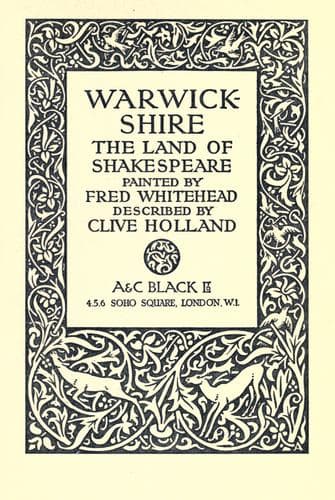
Warwickshire: The Land of ShakespeareHolland, Clive
History
Warwickshire: The Land of Shakespeare
Holland, Clive
Warwickshire (England) -- Description and travel
This latter view has been borne out by modern research, and it has
been now generally admitted that a family or tribe called “Beorm” or
“Berm” gave the place its early Saxon name. More than six centuries
ago, indeed, and for a period lasting four centuries, we find the
name of De Bermingham as lords of the fee. The first was a Peter de
Bermingham, who in the reign of Henry II. in 1154 had a castle here,
and lived in considerable splendour. Here all succeeding members of the
family dwelt until the Duke of Northumberland ousted them in 1537, and
with their ejectment the castle soon fell into ruins and disappeared,
although as late as 1816 a moat and some traces of the walls remained.
In the days of Edward the Confessor the town probably formed part of
the possessions of Ulwin, generally identified with the Alwyne whose
son Turchill founded the Warwickshire family of Arden, of whom the
mother of Shakespeare was a descendant. There is no doubt that the
place was of considerable importance in Saxon times, as proof exists of
the holding of a market there prior to the Conquest.
Although there is no mention in the Domesday Book of any church at
that date, during the rebuilding of St. Martin’s in 1562, some early
stone–work, evidently belonging to a former building and pointing
to the existence of a church dating from before the Conquest, was
discovered. Fairs were certainly held very early in Birmingham’s
existence as a town, and in the Bodleian Library, Oxford, is a curious
MS. map dating from the last years of the thirteenth century, with
a church clearly indicated, in addition to a considerable number of
houses. On this map, where the name is given as “Brymingha,” many
neighbouring towns of traditionally greater importance at that period
are not even marked, and neither Coventry nor Warwick are named.
It would thus appear that in medieval times, although Birmingham must
have been a small town it was also a flourishing one, with a market for
country produce, cattle, hides, etc., which was visited not only by
local traders but by those of adjoining and even distant counties.
Public-domain text, read in full here on John Shaqi.
Reviews
Reviews
No reviews yet
Be the first to share your thoughts on this work.
Elsewhere in the archive
Join the Discussion
Join the discussion
Sign in to leave a comment or review.
Sign InorCreate an account