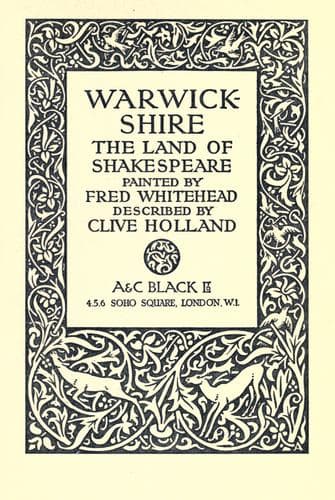
Warwickshire: The Land of ShakespeareHolland, Clive
History
Warwickshire: The Land of Shakespeare
Holland, Clive
Warwickshire (England) -- Description and travel
The first streets that were paved are said to have been High Street,
the Bull Ring, Corn Cheaping, Digbeth, St. Martin’s Lane, Egbaston
Street, Moat Lane, Spiceal Street, and part of Moor Street, and the
streets where the fairs were held. These formed the boundaries of the
town in the thirteenth century; and from this period onwards there was
a distinct and gradual increase of area and also of improvements of an
uninterrupted character.
The most stirring event in the history of Birmingham itself was the
attack made upon it by Prince Rupert on April 5, 1643, during the Civil
War. It created an immense amount of additional antagonism towards the
Cavaliers on the part of the inhabitants, whose sympathies from the
outset of the quarrel between King and Parliament had been with the
latter.
The town was at that period but a small one of about 6000 inhabitants.
But it had caused the King’s party much trouble by having on several
occasions intercepted messengers between the scattered Royalist forces.
These messengers were sent to Coventry and imprisoned. Prince Rupert’s
attack was chiefly prompted by two reasons: the desire for plunder and
the intention to frustrate the completion of the fortifications and
earthworks the inhabitants had commenced. He apparently anticipated
only slight resistance.
The attack was commenced between two and three in the afternoon; two
assaults were repulsed, but eventually the Royalist horse forced an
entry. The Cavaliers rode through the town, with the Earl of Denbigh at
their head, “like so many furies.” People were shot at their windows,
at their doors, and in the streets. Having possessed themselves of the
town the Royalists commenced to pillage it. Next day on leaving the
town they set fire to it in many places.
The effect of all this harshness naturally was to make the Birmingham
folk even more Parliamentarian than before.
The history of Birmingham appears to have been uneventful for more
than twenty years after the memorable visit of Prince Rupert and his
Cavaliers. And the next happening of any great moment was the outbreak
of the plague in 1665, which was said to have been brought to the town
in a box of clothes by a carrier, which he deposited at the White Hart
Inn. The visitation seems to have been a severe one, for it was found
impossible to inter the victims in the usual burying–ground, and a full
acre of land was set aside at Lady Wood Green (known for many years
after as the “pest” ground) for the reception of those who had died of
the plague. The town soon, however, appears to have recovered from this
misfortune, and made, during the ensuing years, from the time of the
Restoration to the commencement of the eighteenth century, a period of
forty years, a progress which can scarcely be considered as otherwise
than remarkable, demonstrated by figures given by Hutton, the accuracy
of which has never been impuned.
Public-domain text, read in full here on John Shaqi.
Reviews
Reviews
No reviews yet
Be the first to share your thoughts on this work.
Elsewhere in the archive
Join the Discussion
Join the discussion
Sign in to leave a comment or review.
Sign InorCreate an account