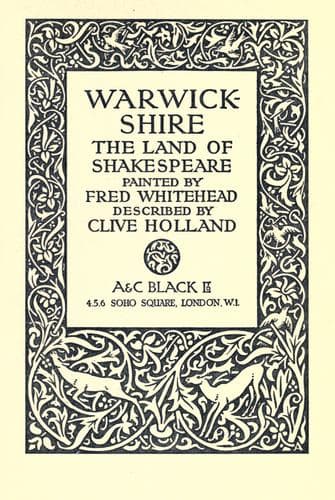
Warwickshire: The Land of ShakespeareHolland, Clive
History
Warwickshire: The Land of Shakespeare
Holland, Clive
Warwickshire (England) -- Description and travel
Although the town in Leland’s day is spoken of as having its chief
beauty in “one streete going up alonge from the left of the brook, up
a meane hill, by the length of a quarter of a mile,” and could have
then been but a comparatively small village, Hutton argues that even
in the days of the ancient Britons the smiths of Birmingham supplied
implements of war and husbandry. It may even be possible, according to
this historian, that the scythes fixed to Boadicea’s chariot wheels
had their genesis at a Birmingham forge. In support of this theory he
quotes that “upon the borders of Aston parish stands Aston furnace,
appropriated for melting iron–stone, and reducing it into ‘pigs’; this
has the appearance of great antiquity. From the melting ore in this
subterraneous region of infernal aspect is produced a calx, or cinder,
of which there is an enormous mountain. From an attentive survey the
observer would suppose so prodigious a heap could not accumulate in a
hundred generations; however, it shows no perceptible addition in the
age of man.”
[Illustration: LITTLE WOLFORD MANOR–HOUSE.]
Before Birmingham became famous for its manufactures it was known
for the great number of tanners resident there; and the hides which
furnished a supply for the rest of the county were laid out in the High
Street in piles on fine days; and in wet weather were deposited in the
Leather Hall. This Leather Market was identified with Birmingham in the
tenth or eleventh century, and continued until the beginning of the
eighteenth century; and it was in this ‘High’ or main street that early
settlers manufactured coarse ironware, nails, and similar articles.
Hutton is inclined to believe that in quite ancient times carpenters’
tools as well as spades, forks, and other implements of husbandry were
made here; and that the worn hollow ways in the roads that proceeded
from Birmingham form additional evidence of the town’s antiquity and
commercial importance. He goes on to observe concerning these rutted
roads, “Though modern industry, assisted by various Turn–pike Acts,
has widened the upper part and filled up the lower, yet they were all
visible in the days of our fathers, and are traceable even in ours.”
This painstaking historian places the ancient centre of the town at
Old Cross from the number of streets which lead towards it, and the
fact of the position of St. Martin’s Church. It is difficult, indeed,
when contemplating modern Birmingham with its fine streets, magnificent
public buildings, and general appearance of wealth, industry, and
prosperity, to realise that the ancient houses were of a type similar
to those at Shrewsbury and Chester. Built principally of timber, with
the space between the beams wattled and plastered over with mortar;
others of slightly more recent date being of bricks and plaster.
Public-domain text, read in full here on John Shaqi.
Reviews
Reviews
No reviews yet
Be the first to share your thoughts on this work.
Elsewhere in the archive
Join the Discussion
Join the discussion
Sign in to leave a comment or review.
Sign InorCreate an account