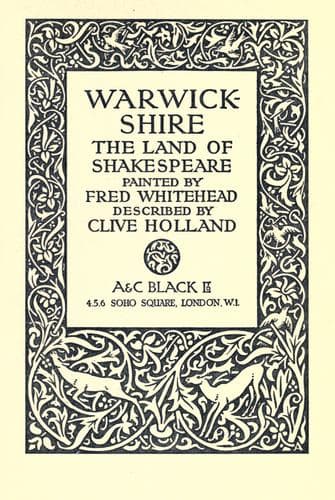
Warwickshire: The Land of ShakespeareHolland, Clive
History
Warwickshire: The Land of Shakespeare
Holland, Clive
Warwickshire (England) -- Description and travel
The great Soho works, in the history of which is, in fact, enshrined
much of that relating to the early days of engineering, have passed
away; the engine factory having been removed to Smethwick in 1848,
after the death of James Watt, the son of the inventor. The site on
which Boulton’s house stood is now occupied by streets and terraces of
unromantic houses. But the memory of Soho lingers in the name of an
open space, and in that of streets and roads.
At the beginning of the nineteenth century the desire to modernise
Birmingham and to erect buildings with some pretension to architectural
beauty seemed to have concerned the inhabitants, and we read, the
town “is daily improving in the style of her buildings; there are now
architects of the first eminence in the town, and others rapidly rising
into notice.”
The progress of Birmingham during the latter half of the nineteenth
century has been wonderfully steady and marked.
Of the ancient town there are nowadays scarcely any survivals;
certainly few buildings of any public character, although “the mansion
house of tymber” which Leland saw and specially mentioned, still
remains in the guise of the “Old Crown Inn,” with several other quaint,
timbered houses in the district of Deritend.
In the old Bull Ring, an historic spot used in former times for the
sport of bull baiting, stands St. Martin’s Church, the most notable
and authentic building in Birmingham, for the modern building erected
in 1872–75, at the cost of a sum of nearly £30,000, stands on the site
of a Norman church of undoubted antiquity. In this ancient fabric,
during the thirteenth and fourteenth centuries, many additions and
alterations were effected, and the walls of the old church were
formerly plentifully adorned with frescoes, representing amongst other
scenes St. Martin on horseback giving part of his cloak to a beggar.
Nowadays the only portion of the old church still standing is in the
tower, but there are some fine altar tombs with recumbent figures of
the old lords of Birmingham in the chancel. One is believed to be that
of the third William de Bermingham, who was at the siege of Belgrade in
France in 1297, and was taken prisoner there. There are also many other
interesting and important memorials, and some extremely fine modern
stained glass by the late William Morris.
[Illustration: LONG COMPTON.]
Public-domain text, read in full here on John Shaqi.
Reviews
Reviews
No reviews yet
Be the first to share your thoughts on this work.
Elsewhere in the archive
Join the Discussion
Join the discussion
Sign in to leave a comment or review.
Sign InorCreate an account