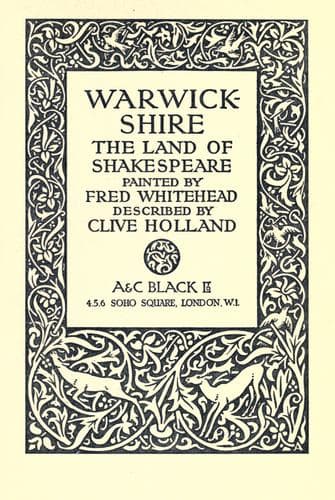
Warwickshire: The Land of ShakespeareHolland, Clive
History
Warwickshire: The Land of Shakespeare
Holland, Clive
Warwickshire (England) -- Description and travel
St. Philip’s Church, which occupies a fine site fronting on Colmore
Row, has an importance other than its architecture from the fact that
it is now the pro–Cathedral. Finely situated, this handsome building
has an added grace and importance from its elevated and isolated
position. The church stands upon ground which was originally part of
a farm called Horse Close, afterwards Barley Close, and the land was
given by one Robert Phillips and the church named after the saint and
also the founder. It was commenced in 1711 from designs by Thomas
Archer, a pupil of John Vanbrugh, who was also the architect for the
church of St. John, at Westminster. The building was consecrated in
1715, although not finished till four years later. It is said to have
cost only £5000.
The church of St. John at Deritend possesses a somewhat remarkable
history. It is a chapel in the parish of Aston, and was the one
referred to by Leland as “a propper chappel” in 1538. At that date
it was a picturesque and interesting Early English building, which
unhappily was demolished about a century ago, and re–erected in the
form of an uninspiring structure of Georgian plainness in brick.
It contains the bust of John Rogers, a native of the district, who
was the first martyr in the days of the Marian persecution. The
original church was founded in 1375 by thirteen persons, who had found
themselves on many occasions unable to reach the mother church at Aston
owing to floods. These provided between them a handsome endowment in
lands, worth at that time ten marks (about £6 : 13 : 4, and nowadays
some £450), the original Charter and Licence in Mortmain are in the
Reference section of the Public Library, and bear dates 1381 and 1383.
The chaplain was formerly strangely elected by household suffrage, both
men and women voting. The last election was in 1889, when a fierce
contest was waged and continued for over a month in thoroughgoing
electioneering style, ultimately thinning out the candidates to two in
number, who went to the final poll, which lasted a day.
Roman Catholicism has a strong following in the city, and the Roman
Catholic Cathedral, dedicated to St. Chad, a seventh–century Bishop
of Lichfield, is a large and handsome though modern building. Erected
from designs by A. W. Pugin in 1839–41 in the Decorated style, it
forms one of the principal churches of Birmingham. In it are some fine
modern stained glass; a sixteenth–century carved oak pulpit brought
from Louvain; and the remains of its dedicatory saint, which are
traditionally stated to have been removed from Lichfield Cathedral at
the time of the Reformation, and more or less miraculously preserved,
and ultimately brought here.
The new era of the town’s history, progress, and wealth began in 1875,
when the late Joseph Chamberlain was elected Mayor.
Public-domain text, read in full here on John Shaqi.
Reviews
Reviews
No reviews yet
Be the first to share your thoughts on this work.
Elsewhere in the archive
Join the Discussion
Join the discussion
Sign in to leave a comment or review.
Sign InorCreate an account