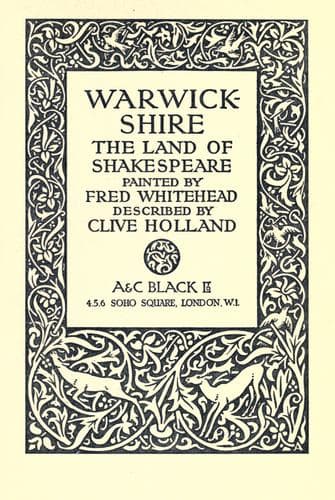
Warwickshire: The Land of ShakespeareHolland, Clive
History
Warwickshire: The Land of Shakespeare
Holland, Clive
Warwickshire (England) -- Description and travel
It is impossible in so brief a sketch as is possible within the
scope of the present volume to deal in detail with the many reforms,
the growth and commercial expansion which the last forty years have
brought about. Birmingham of to–day, with its magnificent Town Hall,
Council House, Museum, and Art Gallery, containing some notable modern
as well as older pictures, and a fine collection of the work of the
pre–Raphaelite School; Free Library; Mason University College; Great
Western Arcade; Midland Institute; Edward VI.’s Grammar School, the
ancient foundation nowadays housed in a modern building by Sir Charles
Barry, R.A., in the Tudor style; Bluecoat School, founded in 1727
for the education of orphans of both sexes; and many other important
commercial, educational, and social institutions, and its fine parks,
may be said to represent a modern city of unique convenience and
considerable structural beauty.
Birmingham, too, has not been without generous benefactors, to whom it
owes a debt not easily repaid. To all who know anything of the city’s
history the names of the Rylands, Jaffray, Tangye, Feeny, and Colmore
families will at once occur.
About modern Birmingham there is indeed a spaciousness and air of
modernity which strikes the visitor almost from the first moment of
his introduction to the town; and although essentially a trade centre,
there certainly hangs about this city, which has owed in later years so
much to the energy, wisdom, and enterprise of such men as John Thackray
Bunce, Joseph Chamberlain, Josiah Mason, George Dawson, George Tangye,
Samuel Timmins, and Philip Henry Muntz, a certain element of even
romantic interest, which, however, is that attaching to modern industry
rather than to survivals of ancient greatness.
Naturally so great an industrial centre as Birmingham played a great
and even distinguished part in the Great War. Very early in the
struggle the city became one of the most important munitions centres
in the Kingdom. Situated in the heart of England, and far distant from
the sea coast, it seemed peculiarly suited for the site of a great
national arsenal, quite irrespective of the fact that for many years
the manufacture of guns and other weapons of war had formed a part of
its most prosperous industrial life.
Although Zeppelins in several of their wanderings over the face of
England, intent upon inflicting injury upon this home of war–time
industry, are reported to have hovered over Birmingham, no considerable
material damage resulted.
Public-domain text, read in full here on John Shaqi.
Reviews
Reviews
No reviews yet
Be the first to share your thoughts on this work.
Elsewhere in the archive
Join the Discussion
Join the discussion
Sign in to leave a comment or review.
Sign InorCreate an account