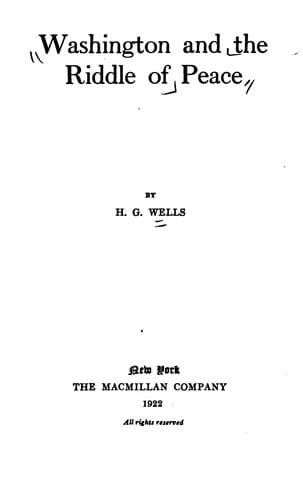
Washington and the Riddle of PeaceWells, H. G. (Herbert George)
History
Washington and the Riddle of Peace
Wells, H. G. (Herbert George)
Conference on the Limitation of Armament (1921-1922 : Washington, D.C.); Peace; World politics
XXV
AFRICA AND THE ASSOCIATION OF NATIONS
Washington, Dec. 9.
In a previous paper I wrote of certain “stifled voices” at Washington.
There is yet another stifled voice here that I have heard, and to speak
of it opens up another great group of questions that stand in the way to
any effectual organization of world peace through an Association of
Nations. Until we get some provisional decision about this set of issues
the Association of Nations remains a project in the air.
This stifled voice of which I am now writing is the voice of the colored
people. As a novelist—a novelist in my spare time—and as a man very
curious by nature, about human reactions, the peculiar situations
created by “color” in America have always appealed to me. I do not
understand why American fiction does not treat of them more frequently.
It is the educated, highly intelligent colored people who get my
interest and sympathy. I cannot get up any race feeling about them.
I am particularly proud to have known Booker T. Washington and to know
Mr. Dubois, and this time, in spite of a great pressure of engagements,
I was able to spend two hours last Sunday listening to the proceedings
of the Washington Correspondence Club, an organization which battles by
letter and interview and appeal against the harsh exclusions from
theatres, schools, meetings, restaurants, libraries and the like, that
prevail here.
I will not discuss here the rights and wrongs of a bar that cuts off
most of the intellectual necessities and conveniences of life from many
people who would pass as refined and cultivated whites in any European
country. I mention this gathering merely to note a very interesting
topic upon which I was called to account thereat.
Once or twice in these papers—I do not know if the reader has noted it—I
have mentioned the French training of Senegalese troops and the
objection felt by other European peoples to their extensive employment
in Europe. I was asked at the Correspondence Club whether the objections
I had made to this were not “fostering race prejudice,” and some
interesting exchanges followed.
I was inclined to argue that the importation of African negroes into
Europe for military purposes was as objectionable as their importation
to America for economic services, but some of my hosts, some of the
younger men, did not see it in that light. They are warmed toward the
French by the notable absence of racial exclusiveness in France, and
they see the ideals of that epoch-making book, “La France Negre,” from
an entirely different angle. Why not a black France as big or bigger
than white France and a new people who have learned military discipline,
military service and united action from Europe?
“Why not an African Napoleon presently?” said the young man, a little
wanting, I thought, in that abject meekness which is the American ideal
of colored behavior.
Public-domain text, read in full here on John Shaqi.
Reviews
Reviews
No reviews yet
Be the first to share your thoughts on this work.
Elsewhere in the archive
Join the Discussion
Join the discussion
Sign in to leave a comment or review.
Sign InorCreate an account