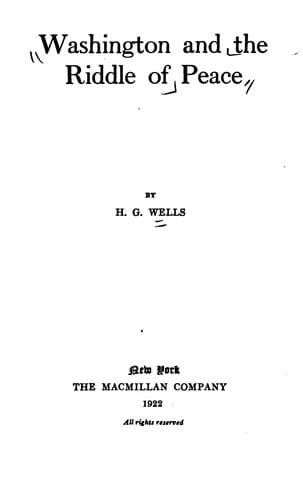
Washington and the Riddle of PeaceWells, H. G. (Herbert George)
History
Washington and the Riddle of Peace
Wells, H. G. (Herbert George)
Conference on the Limitation of Armament (1921-1922 : Washington, D.C.); Peace; World politics
He was imagining, I suppose, something happening in Africa rather after
the fashion of the emancipation of Hayti and of great African armies
pushing their former rulers back to the sea. But Col. Taylor has
recently suggested another possibility, namely, that of France finding
herself in the grip of a black Pretorian Guard. It is a just,
conceivable fancy—a Pretorian Guard, French-speaking and
ultra-patriotic, keeping French Socialists and pacifists and Bolsheviks
in their proper place.
I do not believe very much in either of these possibilities nor even in
the third possibility of European powers fighting each other with black
armies in Africa, but I do perceive that dreams of a world peace will
remain very insubstantial dreams, indeed, until we can work out a scheme
or at least general principles of action for the treatment of Africa
between the Sahara and the Zambesi River, a scheme that will give some
sort of a quietus to the jealousies and hostilities evoked by the
economic and political exploitations of annexed and mandatory
territories upon nationalist and competitive lines in this region of the
earth.
For it seems to be the fact that tropical and sub-tropical Africa has
another function in the world than to be the home of the great family of
negro peoples. Africa is economically necessary to European civilization
as the chief source of vegetable oils and fats and various other
products of no great value to the native population. European
civilization can scarcely get along without these natural resources of
Africa.
Now here we are up against a problem entirely different from the problem
that arises in the case of India, Indo-China and China, which is the
problem of a politically powerless but essentially civilized population
which can be trusted to modernize itself and come into line with the
existing efficient powers if only it is protected from oppressive and
disintegrating forces while it adjusts itself.
Africa is quite incapable of anything of the sort. Negro Africa is
mainly still in a state of tribal barbarism; in the latter half of the
nineteenth century its peoples were in a condition of deepening disorder
and misery due to the spread of European diseases and to the raiding of
the Arab and native adventurers who had obtained possession of modern
firearms. The small village communities of tropical Africa were quite
unable to stand up against the brigand enterprises of mere bands of
ruffians armed with rifles.
Public-domain text, read in full here on John Shaqi.
Reviews
Reviews
No reviews yet
Be the first to share your thoughts on this work.
Elsewhere in the archive
Join the Discussion
Join the discussion
Sign in to leave a comment or review.
Sign InorCreate an account