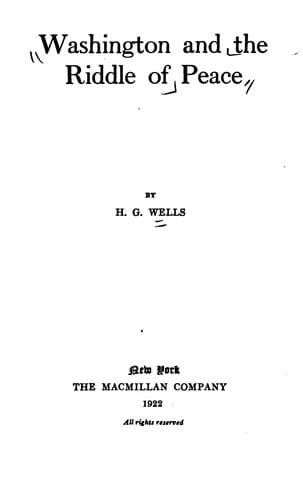
Washington and the Riddle of PeaceWells, H. G. (Herbert George)
History
Washington and the Riddle of Peace
Wells, H. G. (Herbert George)
Conference on the Limitation of Armament (1921-1922 : Washington, D.C.); Peace; World politics
Washington, Dec. 12.
The reader will have seen verbatim reports of the speeches at the fourth
plenary session of the Washington Conference and he will know already
what decisions were handed out to us from the more or less secret
session that prepared them for us.
There has been a good deal of discussion here about the secret sessions
and a certain indignation at their secrecy that I do not share. It is a
matter of decency rather than concealment that men speaking various
languages, representing complicated interests and feeling their way
toward understandings, should not be exposed to embarrassing observation
and comment until they have properly hammered out what they have to say.
It is far better to digest conclusions under cover and to present the
agreed-upon conclusion. This is no offense against democracy, no
conspiracy against publicity. The mischief of secrecy lies in secret
treaties and secret understandings and not in protected interchanges.
There is no sound objection to secret bargaining in committee provided
that finally the public is informed of the agreement arrived at and _of
all the considerations in the bargain_.
The conclusions announced are important enough in themselves; but to all
who care for the peace of the world they are far more important in the
vista of possibilities they open up. Certain notable precedents are
established. The four Root resolutions do put very clearly those ideals
of withdrawal and abstinence which must become the universal rule of
conduct between efficient and politically confused or enfeebled states
if the peace of the world is to be preserved. That is the new way in
international politics. _It is the beginning of the end of all Asiatic
imperialisms._
And, following upon its assent to those resolutions, the conference
voted upon certain special applications of them. The abolitions of the
extra territorial grievance, the right of China as a neutral power to
escape the fate of Belgium and the right of China to be informed on the
article of any treaty affecting her were established as far as a
resolution of the conference could establish them.
And then came Senator Lodge. For the fourth plenary session “featured”
Senator Lodge just as previous ones had “featured” Secretary Hughes, Mr.
Balfour and M. Briand. Fifteen years ago I came to Washington and
Senator Lodge showed me a collection of prehistoric objects from Central
America and talked very delightfully about them. Fifteen years have
changed Washington very greatly but they have not changed Senator Lodge.
Public-domain text, read in full here on John Shaqi.
Reviews
Reviews
No reviews yet
Be the first to share your thoughts on this work.
Elsewhere in the archive
Join the Discussion
Join the discussion
Sign in to leave a comment or review.
Sign InorCreate an account