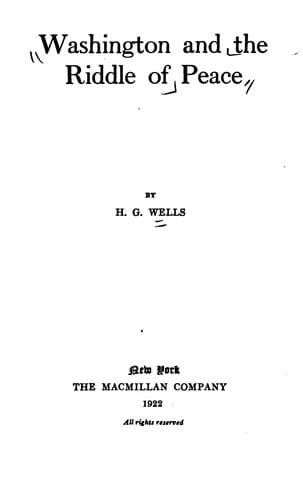
Washington and the Riddle of PeaceWells, H. G. (Herbert George)
History
Washington and the Riddle of Peace
Wells, H. G. (Herbert George)
Conference on the Limitation of Armament (1921-1922 : Washington, D.C.); Peace; World politics
He seems perhaps just a little slenderer and neater than before, but
that may be a change in my own standards, and it was entirely in
character with my former impressions of him that in putting the
four-power treaty before the conference he should indulge himself and
his hearers in a vision of the realities of the Pacific, the
multitudinous interests of its innumerable islands, its infinite variety
of races, customs, climates and atmospheres.
It was a most curious and attractive phase of the always-interesting
conference to have this gray-headed, cultivated gentleman breaking
through all the abstract jargon of diplomacy and militarism, all the
talk of powers, radii of action, fortifications, spheres of influence,
and so forth, in his attempt to make us realize the physical loveliness
and intellectual charm of this enormous area of the world’s surface that
the four-power treaty may perhaps save now and forevermore from the fear
and horrors of war.
The proposed four-power treaty which thus starts upon its uncertain but
hopeful journey toward ratification by the Senates, Legislatures and
Governments of the world is essentially a departure from the normal
tradition of the treaties of the nineteenth century. It is the first
attempt to realize—what shall I call it?—the American way or the new way
in international affairs. Its distinctive feature is the participation
of two possible antagonists, America and Japan. Instead of a war they
make a treaty and call in Britain and France to assist. It is a treaty
for peace and not against an antagonist.
I think that the difference between “treaties for” and “treaties
against” is one that needs to be stressed. The Anglo-Japanese treaty was
a “treaty against,” a treaty against first Russia, then Germany and then
against some vaguely conceived assailant. It is a great thing to have
Japan and England cordially immolating that treaty now that this
four-power treaty of the new spirit may be born.
After Senator Lodge came M. Viviani with a very fine, if guarded,
speech. M. Viviani is a great speaker but he is not merely eloquent, and
I find people here saying little about his wonderful voice or his
overtones and undertones or his romantic charm but much about the subtle
things he said. In a gathering that is tense with attention one is apt,
perhaps, to transfer one’s own thoughts and expectations to the
gathering as a whole, but it seems to me that when M. Viviani rose to
welcome this great beginning on the Pacific, we were all thinking: “And
how much further and to what other regions of the world are you prepared
to extend this spirit and method of this Pacific bond? There is another
rather threadbare ‘treaty against’ or at least an ‘understanding
against,’ known as the Anglo-French entente. Is the time due yet for the
merger of that also in another and greater bond of peace?”
Public-domain text, read in full here on John Shaqi.
Reviews
Reviews
No reviews yet
Be the first to share your thoughts on this work.
Elsewhere in the archive
Join the Discussion
Join the discussion
Sign in to leave a comment or review.
Sign InorCreate an account