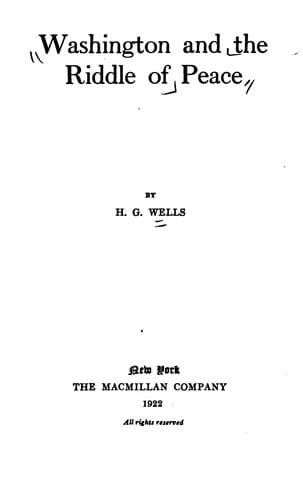
Washington and the Riddle of PeaceWells, H. G. (Herbert George)
History
Washington and the Riddle of Peace
Wells, H. G. (Herbert George)
Conference on the Limitation of Armament (1921-1922 : Washington, D.C.); Peace; World politics
Let us go back to one fundamental fact in the present break-up in human
affairs. That break-up is not a result of debility; _it is a result of
ill-regulated power_. It is important to bear that in mind.
Disproportionate development of energy and overstrain are the immediate
causes of our present troubles; the scale of modern economic enterprise
has outgrown the little boundaries of the European States; science and
invention have made war so monstrously destructive and disintegrative
that victory is swallowed up in disaster; we are in a world of little
nations wielding world-wide powers to the general destruction. And it
follows that if, after all, we do struggle out of our old-fashioned and
now altogether disastrous rivalries and hatreds before they destroy us,
we shall still have all this science and power, which are things that
seem now to increase by a sort of inner necessity, on our hands. So that
getting through to an organized world peace does not mean simply
avoiding death and destruction and getting back to “as you were.” It
means getting hold of power by the right end instead of the wrong end
and going right ahead. We are not struggling simply to escape, we are
struggling for the opportunity to achieve.
Personally, I do not think I would have bothered to come to Washington
or to interest myself in this peace business, and to work and blunder
and feel incompetent and be worried and distressed here, if it meant
working for just peace, flat, empty, simple peace. I do not see why the
killing of a few score millions of human beings a few years before they
would naturally and ingloriously die, or the smashing up of a lot of
ordinary, rather ugly, rather uncomfortable towns, or, if it comes to
that sort of thing, the complete depopulation of the earth, or the
prospect of being killed myself presently by a bomb or a shot or a
pestilence, should move me to any great exertions. Why bother to
exchange suffering for flatness? The worst, least endurable of miseries
is boredom. One must die somewhere; few deaths are as painful as a
first-class toothache or as depressing as a severe fit of indigestion;
you can suffer more on a comfortable death bed than on a battlefield;
and meanwhile, there is a very good chance of sunshine and snatched
happiness here or there. But what does stir me is my invincible belief
that the life I lead and the human life about me are not anything like
the good thing that could be and might be. I am not so much frightened
and distressed by these wars and national clashes and all the rest of
this silly flag-wagging, bragging, shoving business as bored and
irritated by these things. I have had some vision of what science and
education can do for life and I am haunted by the fine uses that might
be made of men and of our splendid possibilities. I do not think of war
as a tragic necessity but as a blood-stained mess. When I think of my
Europe now, I do not feel like a weakling whose world has been invaded
Public-domain text, read in full here on John Shaqi.
Reviews
Reviews
No reviews yet
Be the first to share your thoughts on this work.
Elsewhere in the archive
Join the Discussion
Join the discussion
Sign in to leave a comment or review.
Sign InorCreate an account