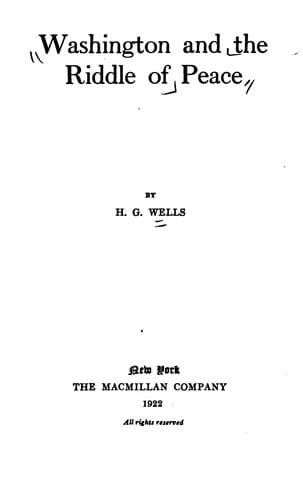
Washington and the Riddle of PeaceWells, H. G. (Herbert George)
History
Washington and the Riddle of Peace
Wells, H. G. (Herbert George)
Conference on the Limitation of Armament (1921-1922 : Washington, D.C.); Peace; World politics
by stupendous and cruel powers; I feel like a man whose promising garden
has been invaded by hogs. There is the pacificism of love, the
pacificism of pity, the pacificism of commercialism, but also there is
the pacificism of utter contempt. This is not a doomed world we live in
or anything so tragically dignified; it is a world idiotically spoilt.
Do any of us fully realize the promise of that garden, the promise that
can still be rescued from the trampling dullness of old animosities and
rivalries which is wrecking it? Given unity of purpose throughout the
world, given a surcease of mutual thwarting and destruction, do we
realize what science has made possible now and here for mankind?
I shall not indulge in any imaginative anticipations of things still
undiscovered in the scientific realm, I will only suppose that things
already known and tested are systematically used all over the world,
that the good knowledge we have already stored in our laboratories and
libraries is really applied with some thoroughness and with some
community of purpose to the needs and enlargement of life.
And first let us deal with the commoner material aspects of life in
which there have been great changes and improvements in recent times and
in which, therefore, it is easiest to imagine still further betterment,
given only an assuagement of strife and blind struggle and a spreading
out of generosity and the feeling of community from international to
social affairs.
Take transport, that very fundamental social concern. It is ripe for
great advances. There is all the labor needed in the world, all the
skill and knowledge needed, and all the material needed, for these
advances. There is everything needed but peace and the recognition of a
common purpose. At present, there are railways only over a part of the
inhabited world; there are vast areas of Asia and Africa and South
America with no railway nor road communication at all and with enormous
natural resources scarcely tapped, in consequence. Roads are as yet not
nearly so widespread as railways, abundant good roads are founded indeed
only in Western Europe and the better developed regions of the United
States; there are a few good main roads in such countries as India,
South Africa, and so forth. And in many parts of Europe now, and
especially in Russia roads and railways are going out of use. Large
parts of the world are still only to be reached by a specially equipped
expedition; they are as inaccessible to ordinary travelling people as
the other side of the moon. And if you will probe into the reasons why
road and rail transport fails to develop and is even over wide areas
undergoing degradation, you will come in nearly every case upon a
political bar, a national or an imperial rivalry. These are the things
that close half our world to us and may presently close most of the
world to us. And consider even the railroads and roads we have; even
those of America or Britain, how poor and uncomfortable they are in
Public-domain text, read in full here on John Shaqi.
Reviews
Reviews
No reviews yet
Be the first to share your thoughts on this work.
Elsewhere in the archive
Join the Discussion
Join the discussion
Sign in to leave a comment or review.
Sign InorCreate an account