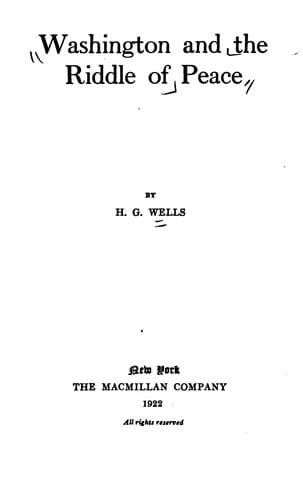
Washington and the Riddle of PeaceWells, H. G. (Herbert George)
History
Washington and the Riddle of Peace
Wells, H. G. (Herbert George)
Conference on the Limitation of Armament (1921-1922 : Washington, D.C.); Peace; World politics
All the fleets in the world could hot prevent a properly prepared Japan
from pouncing upon some unprotected point of the California or Mexican
coast, setting up a temporary air base there, and getting to work over a
radius of a thousand miles. She might even keep an air base at sea. And
it would be equally easy for America to do likewise to Japan. The
citizen of Los Angeles, as he blew to pieces, or coughed up his lungs
and choked to death, or was crushed under the falling, burning
buildings, could at least console himself by the thought that America
was so thoroughly _prepared_ that his fellow man in Tokio was certainly
getting it worse, and that he blew to pieces on the soundest American
lines unentangled by any alliances with decadent Old World powers. And
an air war between America and Japan need not be confined to the Pacific
Slope. I do not see anything to prevent Japan, if she wanted to do so,
with the aid of a venial neutral or so, getting around into the Atlantic
to New York and testing the stability of the great buildings downtown
with a few five-ton bombs. The submarine would certainly be able to
prevent any armies landing on either side of the Pacific to stop the
preparation and launching of such expeditions.
I do not know how American populations would stand repeated bombing. In
the late war there was not a single intrusion of air warfare into
American home life. The hum of the Gotha and the long crescendo of the
barrage as the thing gets near were not in the list of familiar American
war sounds. Some of the European populations subjected to that kind of
thing got very badly “rattled.” And yet, as I have noted, the whole
force of the combatants was not in the air operations in Europe. One
result in nearly every country was an outbreak of spy mania; everybody
with a foreign name or a foreign look in England, for example, was
suspected of “signalling.” There was much mental trouble; London
possesses now a considerable number of air raid lunatics and air raid
defective children, and these are only the extreme instances of a
widespread overstrain. As the war went on, air stress interwoven with
the acute stresses produced in public life by the development of
propaganda. Public life in France, Germany and England got more and more
crazy about propaganda; there was a fear of insidious whispering
mischief afoot, more like the fear of witchcraft than anything else;
until at last it became dangerous and ineffective to make any utterance
at all except the most ferocious threats and accusations against the
enemy. And a kind of paralysis of suspicion even affected the adoption
of inventions. All this mental and moral confusion and deterioration is
bound to happen in any highly organized community that goes into a well
prepared war again. The only difference will be that it will all be
larger, and intenser, and bitterer, and worse. And I will not even
attempt to elaborate the consequences of the economic attack by
Public-domain text, read in full here on John Shaqi.
Reviews
Reviews
No reviews yet
Be the first to share your thoughts on this work.
Elsewhere in the archive
Join the Discussion
Join the discussion
Sign in to leave a comment or review.
Sign InorCreate an account