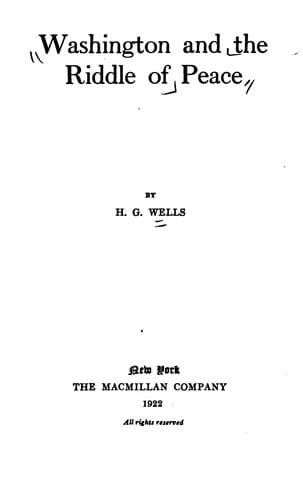
Washington and the Riddle of PeaceWells, H. G. (Herbert George)
History
Washington and the Riddle of Peace
Wells, H. G. (Herbert George)
Conference on the Limitation of Armament (1921-1922 : Washington, D.C.); Peace; World politics
submarines, upon shipping, and by raids of airplane fleets, assisted
possibly by spies and traitors, upon the bridges, factories, depots,
grain stores, ports and so forth, of the combatant countries.
If such things are not practicable across the Pacific now they will be
practicable in ten years’ time.
But my subject at Washington is peace, and not war. I think it was
Nevinson’s recent account of the new things in poison gas that set my
imagination wandering into these possibilities of the Great Alternative
to entangling treaties and difficult settlements. I will return to
certain neglected problems of the Peace Conference in my next article.
XXII
SOME STIFLED VOICES
Washington, December 6.
I do not think my outline sketch of the Washington Conference will be
complete if I do not give an account of certain figures and groups in
this simmering Washington gathering who have no official standing
whatever and who are here in the unpopular role of qualifications and
complications of the simpler conception of the Washington issues. They
are not conspicuous absentees as are Germany and Russia. They come upon
the scene but they come rather like that young woman with the baby who
stands reproachfully at the church door watching the wedding in the
melodramatic picture. They are full of reproaches—and intimations of
troubles yet in store.
The other evening, for example, I found myself dining with a comfortably
housed Corean delegation and listening to the tale of a nation
overwhelmed.
Corea is as much of a nation as—Ireland. She had so recent an
independence that she has treaties with the United States recognizing
and promising to respect her independence. Yet she is now gripped, held
down and treated as Posen was in the days of Prussian possession. She is
being “assimilated” by Japan. “What is to be done about us?” my hosts
asked.
One fellow guest thought nothing could be done because the Corean vote
in the United States is not strong enough to affect an election.
Amid the tumult of voices here one hears ever and again an appeal for
something to be done for Corea. Such appeals are addressed chiefly to
American public opinion, but it is also felt to be worth while to let
Britain know, at least to the extent of letting me in on this occasion.
I was introduced to an editor of a Corean paper which had recently been
suppressed, and I listened to an account, an amazing account, of the
freedom of the press as it is understood in Corea under Japanese rule.
Yet it sounded very familiar to me. Indeed, I had listened to much the
same story of suppressions, rather worse suppressions, the night before.
Then I had been the host of two friends of mine, Mr. Houssain and Mr.
Sapre, who have had extensive experiences of suppression in India. They
are both here in much the same spirit as the Coreans.
Public-domain text, read in full here on John Shaqi.
Reviews
Reviews
No reviews yet
Be the first to share your thoughts on this work.
Elsewhere in the archive
Join the Discussion
Join the discussion
Sign in to leave a comment or review.
Sign InorCreate an account